This research reflects firstly on the aesthetic perspective to the usage of light in an image and then looks at how a different perspective can be reached and a different outcome achieved by considering light from an artistic or expressive point of view rather than a purely aesthetic one.
Aesthetics Alone
This perspective is that which one would most likely read about in a popular press photography magazine. Here they would most likely give the following advice:
- Take the shot in the ‘golden hour’ at the start or end of the day;
- If not then at least aim for morning or late afternoon so that there would be some shadows and contrast;
- If wanting a night shot then probably aim for the blue hour; or
- They would almost certainly tell you to avoid the middle of the day when the light would be harsh, and there would be a lack of contrast.
The tutorial from the Digital Photography School (Rowse, n.d.) is a perfect example of the advice given above.
What is apparent is that the advice is dispensed solely based upon the way it would make an image look. It seems to define a set of rules that will end up with most images looking roughly the same in terms of their tones and contrast and very little thought would have been put in to the why exactly the shot was taken at a specific time.
Considering Light for Expression
In contrast to the pure aesthetic considerations, two photographers researched here take very different approaches to the use of daylight.
Sally Mann
In an interview Mann said “There is no coating on the lens of my old camera, which permits a much softer and more luminous light. I am less interested in the facts of a picture than in the feelings. The facts don’t have to be absolutely sharp. I can get information across by appealing to viewer’s emotions.” (Rong, 2010).
This point of view is totally in contrast to the aesthetic consideration. Mann talks of putting her attention towards expressing emotion. In her interview she wants to show the feeling expressed by the soft southern light, she is less concerned, in fact not much concerned at all with the technical accuracy. Figure 1 below is a good example of this.
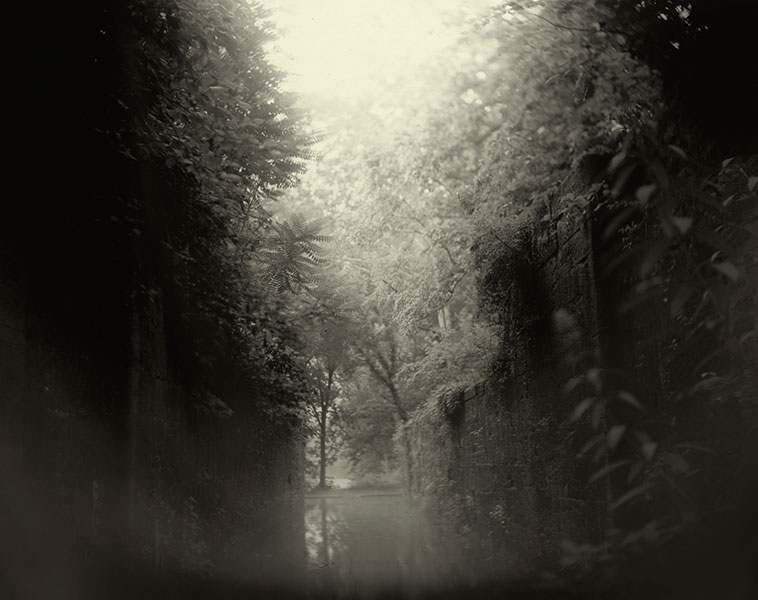
Whilst a traditional photographer might have concerned themselves in how to balance the forest trees with the bright sky light in the top centre of the image, Mann has chosen to capture the image in a way that accentuates the light. A beautiful soft glow is the main focus of the image, the trees that are also present become a frame for the light itself.
As Mann’s images are in black and white, there is no clue as to what time of day the images are captured however given the bright glow that the light is creating, I suspect the timing was judged so that the framing of the trees would capture a shot directly into the sunlight, or close to it.
Michael Schmidt
Schmidt on the other hand takes a view that is an opposite to Mann. In an article of his he says “Photography was invented to enable us to portray reality with complete precision to the last detail. There is no other medium – apart from media which derive from the invention of photography (e.g. film and television) – which is in a position to document reality exactly as it is by means of technical process. This is how I regard photography.” (Schmidt, 1979).
Whereas Mann was primarily concerned with emotion, Schmidt is concerned with the accuracy with which he captures physical reality.
In terms of using the light, in the same article Schmidt says “I prefer to work with neutral diffused light, i.e. to produce an image without noticeable shadows. The viewer must allow the objects portrayed in the photograph to take their effect upon him without being distracted by shadows or other mood effects.” (ibid.). Schmidt chooses to eliminate any influence that light might make to the viewers emotions and deliberately therefore aims for no shadows and soft neutral light.
An example of Schmidt’s images is shown in Figure 2.
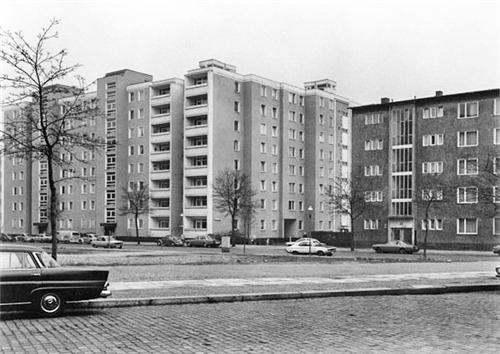
The image is very neutral across its whole area. The only shadow that can be seen is directly under the car at the front, left hand edge. The shadow is directly underneath the car and so I think that the image is likely captured towards the middle of the day.
Learning Points
This piece of research has highlighted the popular press approach to using light which is largely aesthetic versus an artistic or expressive approach.
Looking further at the artistic approach the two example photographers take very different views. Mann is concerned with using light to express an emotion, Schmidt is concerned with using light to portray a neutral image in order to allow a viewer to derive their own emotions. Either approach, and there are of course many others that could be taken, considers emotion and expression and the effect that light has on those things. This is the key learning point to take forward, choosing the light in which to capture an image needs to be more considered than simply what it looks like; the choice of light needs to be at least congruent with the desired emotion of the image and can possibly used to set that emotion in its own right.
Bibliography
Rong, J. (2010). INTERVIEW: Sally Mann – “The Touch of an Angel” (2010) – ASX | Photography & Culture. [online] AMERICAN SUBURB X. Available at: http://www.americansuburbx.com/2013/01/interview-sally-mann-the-touch-of-an-angel-2010.html [Accessed 18 Jun. 2017].
Rowse, D. (n.d.). Bright Ideas For Shooting In Midday Sun. [online] Digital Photography School. Available at: https://digital-photography-school.com/bright-ideas-for-shooting-in-midday-sun/ [Accessed 18 Jun. 2017].
Schmidt, M. (1979). MICHAEL SCHMIDT: “Thoughts About My Way of Working” (1979) | #ASX. [online] AMERICAN SUBURB X. Available at: http://www.americansuburbx.com/2010/10/michael-schmidt-thoughts-about-my-way-of-working-1979.html [Accessed 18 Jun. 2017].
Images
Figure 1. Mann, S. (1996). Virginia 04. [image] Available at: http://sallymann.com/selected-works/southern-landscapes [Accessed 20 Jun. 2017].
Figure 2. Schmidt, M. (1979). Berlin-Stadtbilder. [image] Available at: http://www.americansuburbx.com/2010/10/michael-schmidt-thoughts-about-my-way-of-working-1979.html [Accessed 20 Jun. 2017].