Neon Lights
Sato Shintaro is a Japanese photographer who has created a number of series of images that capture Tokyo at night. A screen shot from his sight is shown in the image below (Shintaro, 1999)

The set of images linked to in the course materials are focussed exclusively on the neon signage within the city. Whilst at first glance they look much like a set of images I would have expected of a night time Tokyo, a second look reveals that there are no people – this is certainly something that one would not expect to see in Tokyo. In his personal statement for the project (ibid) , Shintaro himself says:
Take a brightly-lit busy street bustling with people and remove the people: the purpose of the lighting is lost and only the glow remains – providing a glimpse of the streets we know well from a less familiar perspective.
The statement says everything. By removing the people, one is left studying the lights themselves, not distracted by the people. Figure 2 below is one of my favourite images, the street is deserted but is full of bikes. One is left to wonder where have all the people gone but once you get past that, one of left studying the scene itself. This effect is what I was aiming for when I captured the surrounding areas of Camden in Assignment 3 although my tutor felt it might have been better with people in it, I am not so sure.
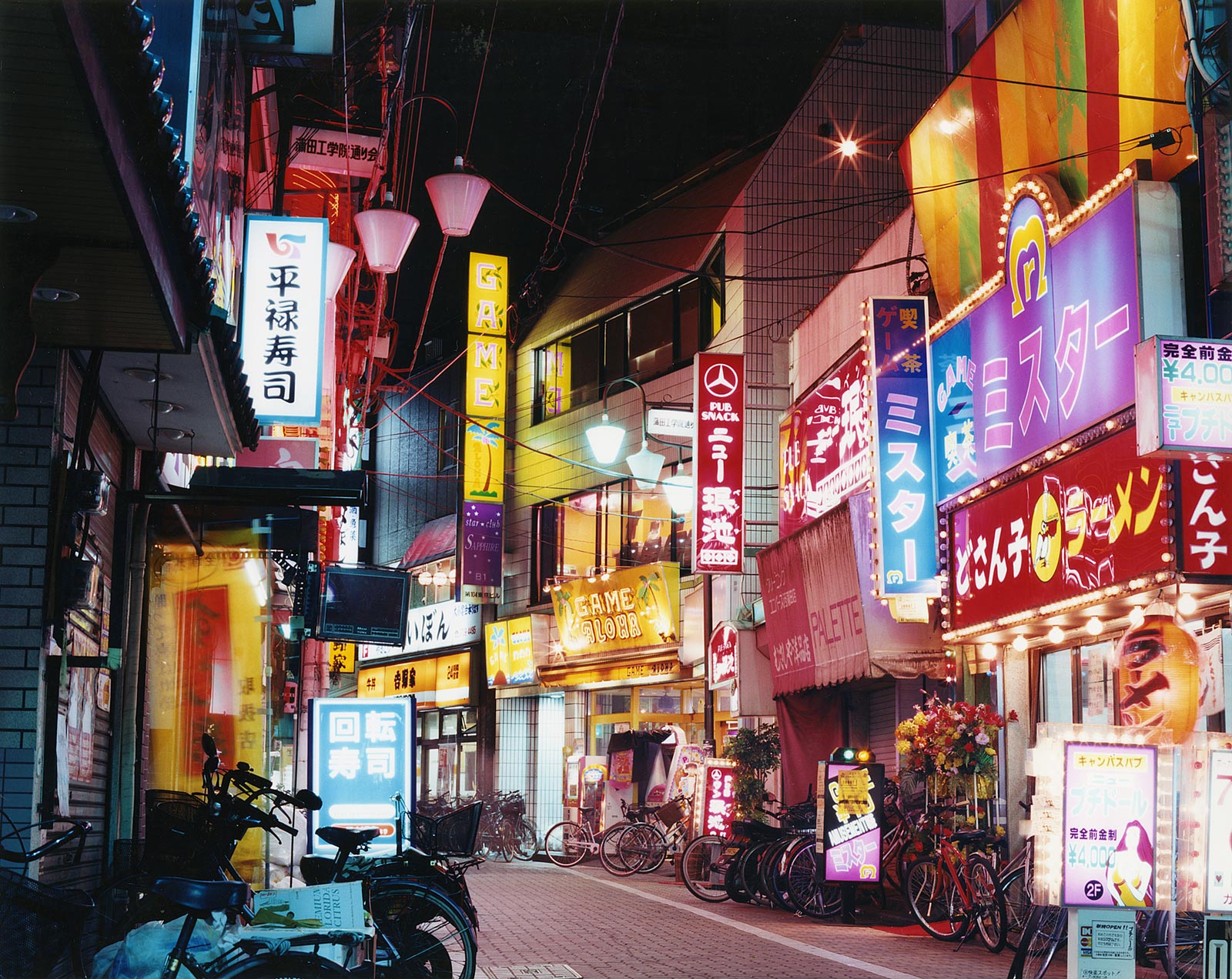
In an interview (Japanexposures.com, 2009), Shintaro reveals how he manged to capture the shots without showing any people in them.
This series is special, because each shot needs just 30 seconds, but I have to cover up my lens when people show up in the frame. So sometimes I have to cover up my lens and wait for several minutes until people dissapear from the frame. So to make a 30 seconds exposure, I have to be shooting in this place for about 30 minutes. It could be very frustrating, when someone shows up and starts using his cell phone. I want to say, “Get out of here!”
This reminds me of my Waterloo station images and the very long exposures that made the people disappear. Here though, Shinatro’s 30 second exposures are made up of fragments of many shorter exposures, an interesting and clever technique.
Tokyo Twighlight Zone
In a different series of work entitled Tokyo Twilight Zone (Shintaro, 2007), Shintaro has created an interesting set of images that portray the city sky line from views that one would not often see. Figure 3 below shows one of my favorurite images in the series. I like the image because it does not show any particular landmark that would perhaps capture all of one’s attention, instead it is simply a scene of the city and helps the viewer gain an appreciation of what the city in normal life feels like.
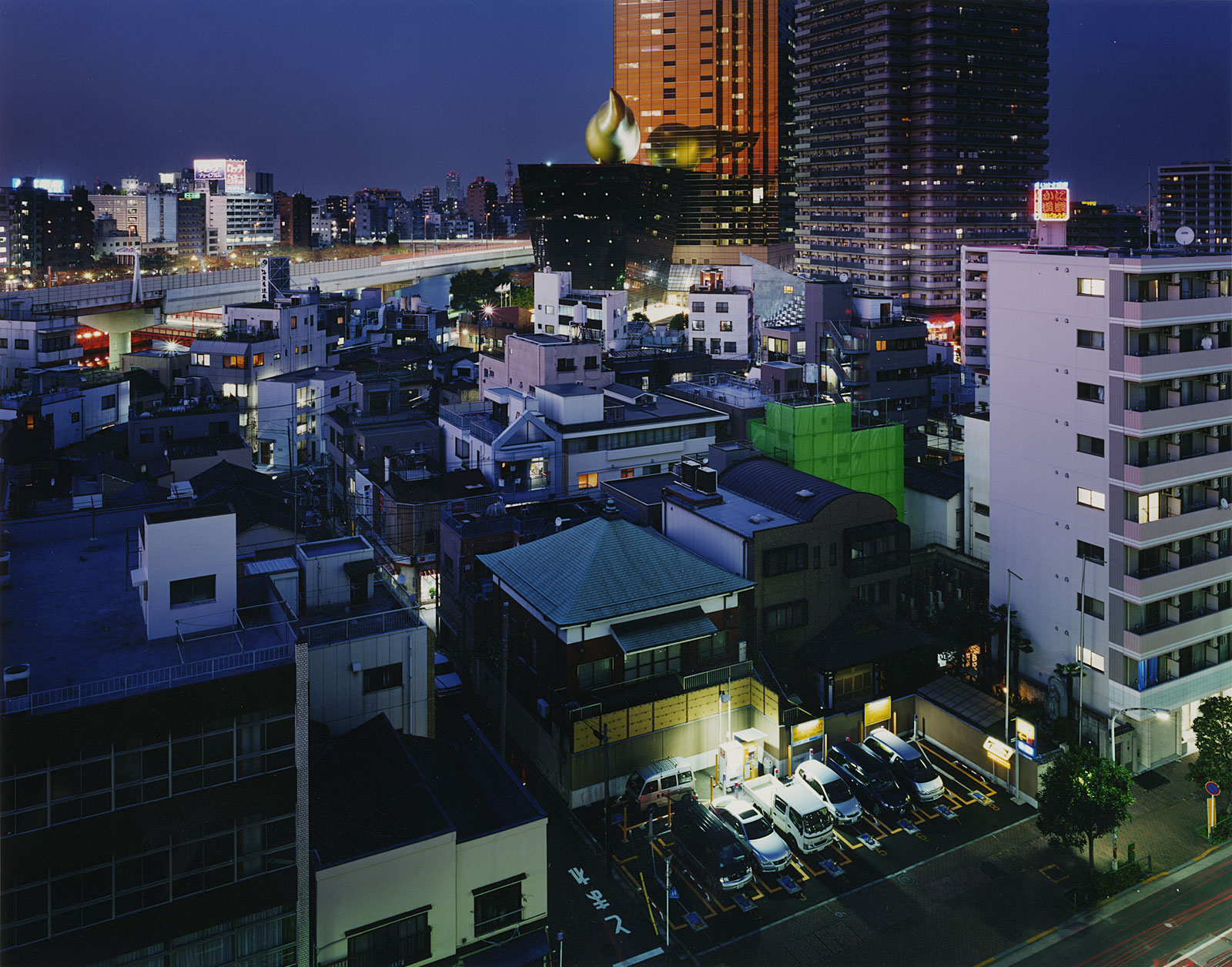
Shantaro himself says the following about his images in this series
I photograph Tokyo from fire escapes .The view from a fire escape is different from either the kind of view afforded by observation decks constructed at sightseeing spots or the vertical perspective of satellite images that are readily available to anyone with a computer .It’s a very personal perspective that I obtain only at the expense of a good deal of physical exercise walking all over town to find just the right place
This approach to capturing his images explains my reaction to them that I described above.
Summary
Shantaro has taken pictures of streets and pictures of skylines – this does not sound impressive but dig a little deeper and his unusual techniques serve to make his pictures very different.
With Neon lights his fragments of exposure to eliminate people leaves only the street and lights to be studied. In Tokyo Twilight Zone his vantage points of fire escapes has created a a perspective on the city that feels intimate and an incite onto the communities within the city rather than the famous landmarks.
His approaches show how creativity in technique can feed forward into creative images too. This is an incite for me as I had been thinking that perhaps technique would take on lesser importance as I shift my focus onto creativity and expression.
Bibliography
Shintaro, S. (1999). Night Lights. [online] Sato-shintaro.com. Available at: http://sato-shintaro.com/work/night_lights/index.html [Accessed 23 Jul. 2017].
Japanexposures.com. (2009). Interview with Shintaro Sato | japan exposures. [online] Available at: http://www.japanexposures.com/2009/08/25/interview-with-shintaro-sato/ [Accessed 23 Jul. 2017].
Shintaro, S. (2007). Tokyo Twilight Zone. [online] Sato-shintaro.com. Available at: http://sato-shintaro.com/work/tokyo_twilight_zone/index.html [Accessed 23 Jul. 2017].
Images
Figure 1. Sato Shintaro (2017) [Webpage] At: http://sato-shintaro.com/work/night_lights/index.html [Accessed 23 Jul. 2017].
Figure 2. Shintaro, S. (1999). 09 Night Lights. [image] Available at: http://sato-shintaro.com/work/night_lights/index.html [Accessed 23 Jul. 2017].
Figure 3. Shintaro, S. (2007). Tokyo 2007. [image] Available at: http://sato-shintaro.com/work/tokyo_twilight_zone/index.html [Accessed 23 Jul. 2017].