Background
Martin Parr is a British photographer who captures images that take a largely satirical view on human life (Wikipedia, 2017). Figure 1 below taken from Parr’s own website (Parr, 2016) is a great example of the satire that flows through all his images.
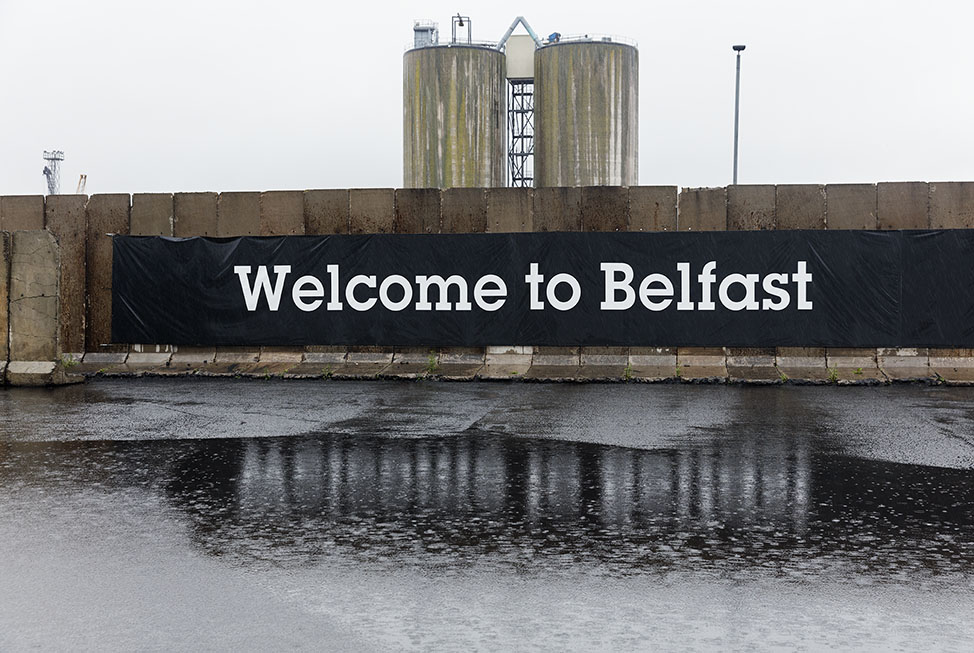
In his own documentary video (Parr, 2011) Parr discusses that the main problem he sees in the world is the excess wealth and greed, he includes himself in this problem, and it is his commentary on this that he aims to capture with much of his photography. Whilst the images are satirical, and as a set even more so, the underlying reason for capturing these images is to comment on what he sees as a serious problem in society.
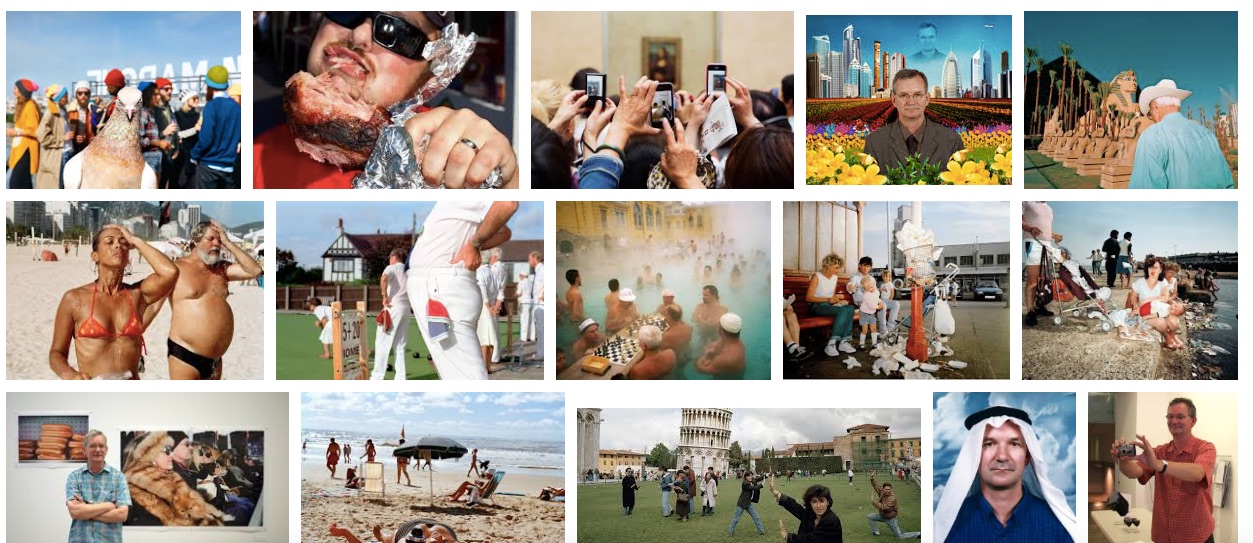
Although he captures images that might loosely be called street photography on the basis that he captures people out and about in towns and public places, a google image search as shown below reveals a very different style of photography to that of, say, Winogrand (as it happens, Winogrand is one of his favourite photographers which he discusses in his video). The first thing that jumps off the page when looking at these search results are the bold bright colours and a closer inspection of the images reveals almost a snapshot like look and feel.
The Importance of a Set
The snapshot like style of a single image sometimes fails to convey the underlying satirical intent that Parr is looking to create; a casual observer may simply assume that the image is indeed a snapshot. It is only when the set, or the series of images, is viewed that one starts to understand the impact that the set itself makes to the interpretation or meaning of the image.
In figures 2 to 4 below, each alone is bordering on a simple family snapshot. Viewed as a set, the experience is different.
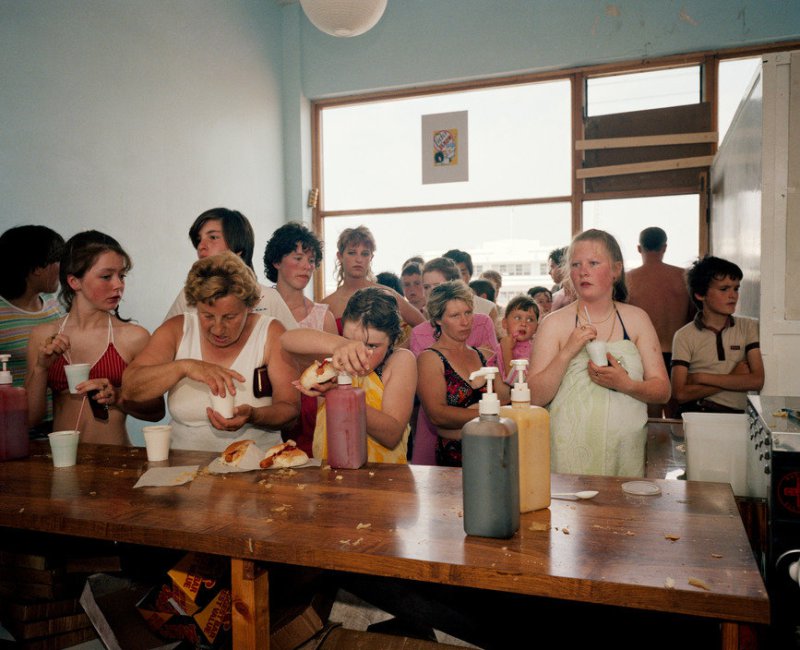
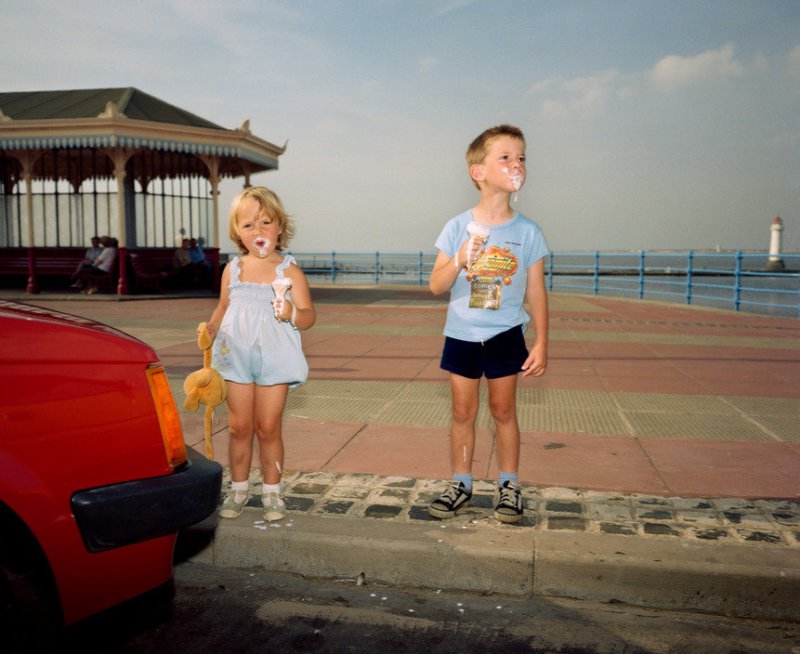
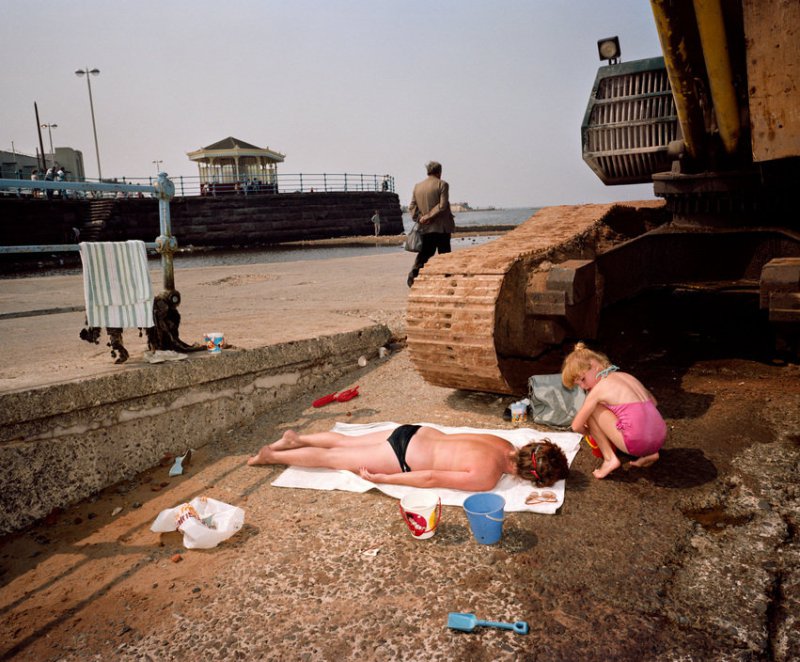
Viewed as a set, one can start to appreciate the satire, the commentary on humans spending their time at the beach. Although non of the images are comic in themselves, the underlying commentary that emerges from viewing the set is indeed comic. Parr’s statement on society in plain to see.
Capturing Images
In the early part of the documentary on Parr (Parr, 2011), he can be seen capturing images at Ascot and it is very striking how he simply walks up to people, gets very close, and takes an image. This brazen, unapologetic attitude is one that, at the time I am writing this research, I have yet to develop. The idea that I can simply walk up to someone and photograph them fills me with dread yet, in this film at least, nobody seems to mind. When some people do ask what he is doing or who he works for, he just talks to them in a very friendly, unapologetic way, probably makes a joke and all seems fine.
Bibliography
Wikipedia. (2017). Martin Parr. [online] Available at: https://en.wikipedia.org/wiki/Martin_Parr [Accessed 10 May 2017].
Parr, M. (2016). Recent Work 3 | Martin Parr. [online] Martinparr.com. Available at: https://www.martinparr.com/recent-work/recent-work-3/ [Accessed 10 May 2017].
Parr, M. (2011). Photography-Martin Parr VPRO. [online] Available at: https://youtu.be/dDlnjtVGLOo [Accessed 10 May 2017].
Images
Parr, M. (2016). Welcome To Belfast. [image] Available at: https://www.martinparr.com/wp-content/uploads/2016/10/PAM2016043G01532.jpg [Accessed 10 May 2017].
Parr, M. (2009). From The Last Resort. [image] Available at: http://pro.magnumphotos.com/C.aspx?VP3=CMS3&VF=MAGO31_10_VForm&ERID=24KL5357TF [Accessed 10 May 2017].