Introduction
Chunking Express is a film written and directed by Kar-Wai Wong produced in 1994. The film makes use of an interesting technique on a few occasions within the film that could be replicated in single shots too.
Slow Shutter Speed Technique
The cinematographer for the film was Christopher Doyle (Shahnawaz, 2014) who uses a combination of slow shutter speed and camera panning to create a visible blurring of the scene whilst keeping the main character sharp.
Figure 1 shows an isolated frame from the scene.
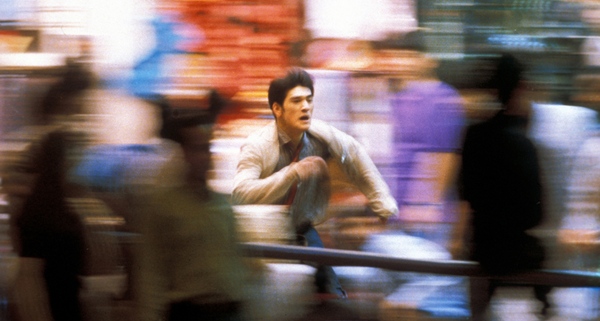
In a film shot in the normal way (a higher shutter speed and panning), the viewer may perceive the background to be blurred but an isolation of a single frame would reveal a much sharper scene than can be seen in Figure 1.
The effect is quite mesmerising. The character seems somehow disconnected from the scene, our focus switches exclusively to the character in a manner similar to using a short depth of field to isolate a subject in a still image. Here though, the subject is not just isolated from the background, it is as if the subject is isolated from the space itself and from the pace of time in that space, like he is in a parallel universe operating at a different pace to the world around him.
“The use of this effect really helped in making the audience feel lose and dizzy just like the characters in the film” (Shahnawaz, 2014)
“he races past a series of neon streaks, creating the impression that he’s somehow been dislodged from his surroundings—not in space, but in time.” (D’Angelo, 2013)
When viewed, the viewer is not quite sure if the film is slow motion or fast motion. D’Angelo concluding that it is “other motion” (ibid, 2013).
This approach has been used in the film during periods of high action. Yet, due to this ‘other motion’ effect, one does not perceive the film to be an action film at these points, the perception for the viewer remains one of the subject being detached from his surroundings in both space and time.
“Many scenes that are in slow motion are also scenes that involve intense action, and in this case, the use of slow motion adjusts the pace of the intense scene so that the movie doesn’t turn into an action movie.” (Ibfilmsas.wikispaces.com, 2013)
Reflection
In my research of Ultra Long Exposures, I reflected that the images successfully capture the notion of time itself within a single image. Here the effect is different. Time is a factor, but the effect is one of detachment from time, speed of time for the subject is different to that of his surroundings. Thus, in one image, the notion of two different passages of time, is captured.
Again I am intrigued by the idea that time can be portrayed in a single image and this is something that I would like to explore further. The first thing that comes to mind is my morning commute using London Public Transport in which I often feel somewhat detached from the busy commuters around me, I intend to explore this idea there.
Bibliography
Shahnawaz, S. (2014). CHUNGKING EXPRESS – ANALYSIS OF CINEMATOGRAPHY. [online] SHEIKH SHAHNAWAZ. Available at: https://sheikhshahnawazyr2.wordpress.com/2014/10/15/chunking-express-analysis-of-cinematography/ [Accessed 16 Apr. 2017].
Scene from Chunking Express. (2014). [image] Available at: https://sheikhshahnawazyr2.files.wordpress.com/2014/10/ck4.jpg [Accessed 16 Apr. 2017].
D’Angelo, M. (2013). How Wong Kar-Wai turned 22 seconds into an eternity. [online] The Dissolve. Available at: http://thedissolve.com/features/movie-of-the-week/221-how-wong-kar-wai-turned-22-seconds-into-an-eternit/ [Accessed 16 Apr. 2017].
Ibfilmsas.wikispaces.com. (2013). ibfilmsas – Chungking Express. [online] Available at: https://ibfilmsas.wikispaces.com/Chungking+Express%C2%A0 [Accessed 16 Apr. 2017].