Introduction
Ruff has created a series of artworks which take images, either his own or others found on the internet, and applied heavy jpeg compression to create an artefact effect across his images. One of his collections is called JPEG, this note discusses two reviews of his work, one by Campney (2008) and one by Colberg (2009).
An example of Ruff’s images is shown in (Fig 1).
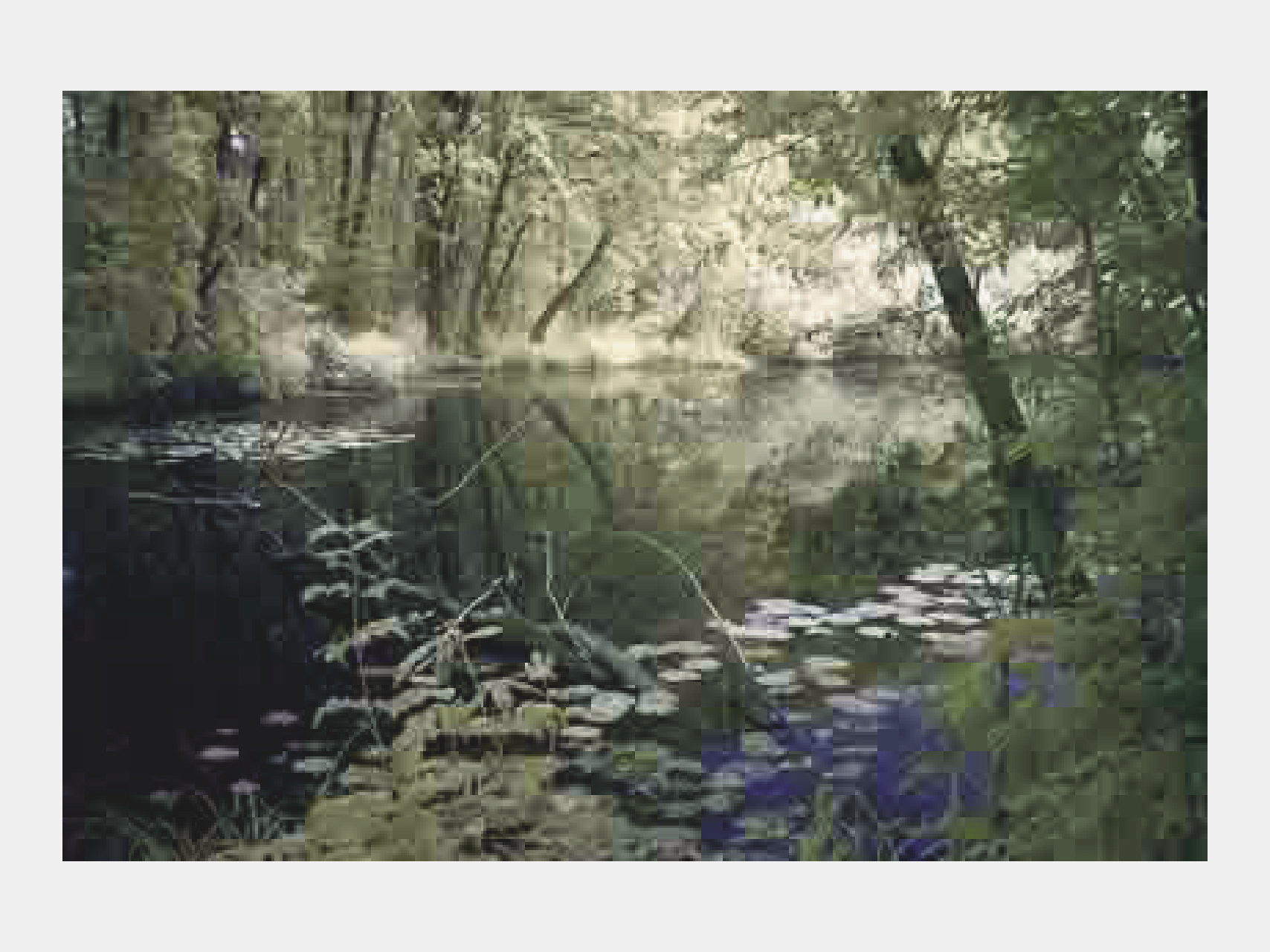
Fig 1. Jpegs II (Ruff, 2008)
Campney
Campney discusses that the treatment of the images makes them detached from the lifelike image that was their source, making them ‘cold and dispassionate’. He highlights that some find the images art whilst others do not and are dismissive of the work.
He discusses Ruff’s usage of media available from the internet and considers whether Ruff is creating a new archive from what is essentially a global archive, itself drawn from other archives, this idea of nested archives could cover many iterations. Whilst some of the other commentaries on Ruff focus on the images alone, there is a strong focus in this review on the archival nature of Ruff’s work, the curation of the images being as essential to the collection as the manipulation of the images themselves.
The serial nature of Ruff’s work is discussed, and as as a result, Ruff’s thought process over an extended period of time can be traced by reviewing the evolving nature of the images that have been curated along this same extended period of time (rather than a set of images being created at a single time).
Finally, Campney discusses that the topics selected by Ruff represent complex issues that cannot be captured in a single image, or a set of images, and that the pixilation of the images creates a sense of abstraction or detachment from the image which itself represents this concept of the image being an abstraction from the real complex event.
Colberg
In Colberg’s review, his focus is very different to that of Campney and concentrates mainly on the visual aesthetics of the images.
He begins by discussing that the images in his view are best viewed in book format where it is possible to appreciate the whole image and its blocks rather than the ‘gigantic’ prints used in a gallery.
Colberg then focusses on the nature of the images. Whilst he is clear that ‘there is nothing wrong with producing beautiful images or images that are “just” beautiful’, he is uncomfortable that perhaps this is all there is to Ruff’s work. He feels that the images, or the series of images, feel as if they are starting to build into something more meaningful than just the way they look but then fall back to the aesthetic only consideration as Ruff moves on to another topic, this aligns to Campney’s view of the images being serial in nature and changing alongside Ruff’s thought processes.
Summary
The two reviews are very different. Campney investigates the meaning of Ruff’s work, it discusses the archival nature of the work and the abstraction that is created by the work. Colberg discusses only the aesthetic nature of the image and suspects that perhaps there is nothing more to the images than that.
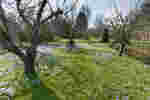
The following is an example taken from one of my own images submitted for Exercise 1.3. The number of pixels and the image quality were reduced. I do not feel that the resultant effect is something that adds to this particular image although different results could be obtained through different resizing options.
Bibliography
Campney, D. (2008). Thomas Ruff: Aesthetic of the Pixel – David Campany. [online] David Campany. Available at: http://davidcampany.com/thomas-ruff-the-aesthetics-of-the-pixel/ [Accessed 5 Mar. 2017].
Colberg, J. (2009). Conscientious | Review: jpegs by Thomas Ruff. [online] Jmcolberg.com. Available at: http://jmcolberg.com/weblog/2009/04/review_jpegs_by_thomas_ruff/ [Accessed 5 Mar. 2017].
Figures
Figure 1: Ruff, T. (2008). Jpegs II. [online] Fineartmultiple.com. Available at: https://fineartmultiple.com/buy-art/thomas-ruff-jpegs-ii/ [Accessed 5 Mar. 2017].