Demonstration of technical and visual skills
I think that my assignment includes a good range of different industries and how they appear across the western Cotswolds. What strikes me most with this outcome is that I don’t think I would have produced such a set of images a year ago when I started this course. By that, I mean that I don’t think I would have spotted, or seen, the environment in the way that I have seen it here.
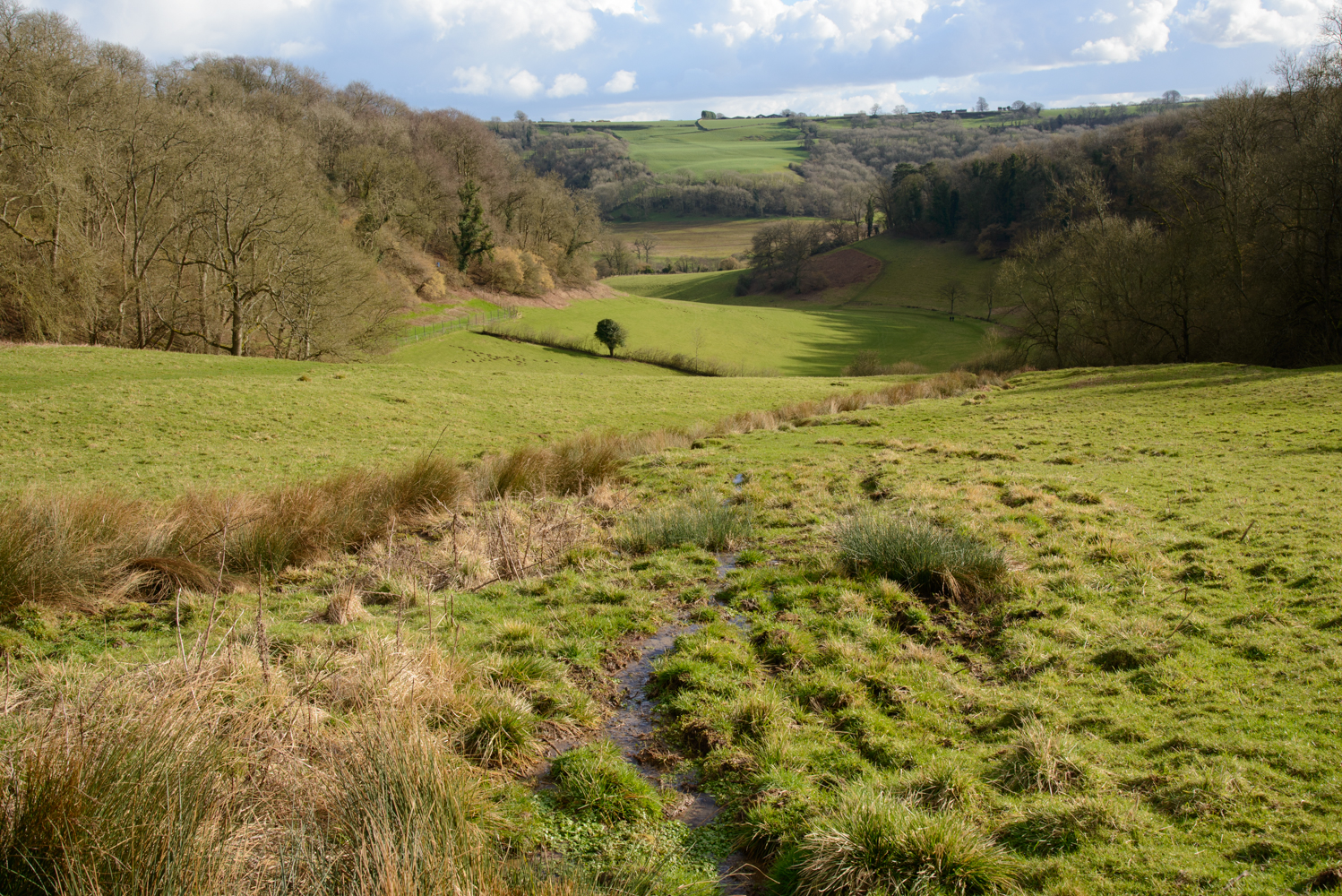
In my initial thinking, for this assignment, I have already written that I would likely have produced a set of images such as Fig 1 below. Where I think I have developed is not just in the intellectual understanding of different ways to look at the landscape but also in my visual awareness skills in order to see or identify the scene. Sheep Grazing Under Pylons is a good example of this. Whilst I might previously have driven past this scene and thought what a shame it is that the pylons are ruining the scene, now I drive past and am captured by the interplay of the countryside, the man-made pylons, and the farming activities.
All of the scenes captured in my assignment were spotted in this way, I simply drove around with the idea of the assignment in my head and came across things that I wanted to capture.
Technically, the images are shown muted in the dull winter light, this is deliberate. I chose to look for scenes when the light was like this as I wanted a consistency across the set and I wanted the focus of the viewer to be on the content of the image in detail rather than mistaking it for a more typical aesthetic-orientated landscape image that has been ‘spoiled’ by the man made elements. On occasion this was technically challenging as when the sun did come out, or even when the sky was just bright, the light was very harsh causing deep shadows and blown skies. I have managed to control this in images I have submitted but some on the contact sheets were a little too far to correct, West Cotswolds – 2 being a good example. Developing this theme further, I would look to return to some of these sights when the weather and lighting was more supportive of the outcome I am looking to achieve; perhaps the best example of my submitted images that would benefit from this is Dairy Farming, Upper Coberley where the bright blue streaks in the sky are a little distracting, I was tempted to edit them out but chose to submit all images unchanged other than minor adjustments to brightness, contrast and saturation. Another example would be Renovated Mill where the strip of grey sky immediately above the building would be better if it had some interest to it, again I chose not to artificially change it even though I am slightly worried that it draws the eye out of the image rather than frame the building.
Overall I am pleased with the technical quality of these images but more pleased with the broader awareness I think I have developed in my visual skills and my ability to see things that I would not have seen before.
Quality of Outcome
One of the criteria for this aspect of reflection is conceptualisation of thoughts. I think this is the area that I needed to develop most over this course. In all assignments to date, there have been images that I have chosen that have strayed from the theme I was trying to convey. This has improved over the course and I think I did a good job in Assignment 4, but there were still two images that crept in which did not really fit my theme.
For this assignment, I started out with the theme – industry in the West Cotswolds countryside – and then, without too much of a pre-conceived strategy went out and captured around 500 images. When it came to editing I struggled on the first pass to get down even to 20 images, and then when I had got to 10, it still felt that it was wrong but I was not sure why.
I pressed on and started to write up my assignment, in 300 words. This I also struggled with but eventually got there. I found that being forced to conceptualise my ideas into just 300 hundred words forced me to establish very clear thought patterns and to get the concept right. I had already thought about land and man or industry in the countryside, that was my theme after reading Land Matters (Wells, 2011) and Perspectives on Place (Alexander, 2015), but in writing down my concept, I realised that my theme was actually observing that interplay or juxtaposition and capturing how interesting and beautiful the countryside still is not in spite of the industry, but because of it. This was an evolution of my theme.
With that evolution identified, it suddenly became easier to re-edit my collection. West Cotswolds -14 is an example here. I found the dilapidated factory an interesting subject and took many images of it outside this assignment, but whilst it could fit into a general ‘industry in the country’ theme, it plays no part in my evolved theme, even though I had deliberately framed it to include the countryside in the background.
It is easy to get wrapped up in trying to produce 10 perfect images, but I think forcing myself to write down my ideas in succinct form is a great technique to gain clarity on the idea and I will take the approach forward into future work.
Demonstration of Creativity
Thinking of experimentation, I was very keen to try and create an assignment using black and white, especially after my visit to the Monochrome exhibition at the National Gallery. I had thought that in terms of expression it would help convey such a sense of timelessness that historic images (such as Old Barn) would better coalesce into a set with modern images (such as Dairy Farming). What I found was that whilst the images did form a set, I felt that the set as a whole detached itself from the present day and that felt wrong. The beauty I wanted to express sits in the now, not in the past. So I reverted to colour and for me, that fixes that issue.
Whilst processing images in black and white, I wanted to deliberately process them in a way that had slightly reduced contrast and pull the images away from 100% white or black. This again was part of my idea to create a sense of timelessness. This approach would make the images look more like those of old.
When I switched back to colour, I found that the contrast adjustments I had made have resulted in a muted look that I think still helps to pull the set together. So I have left that in place.
Thinking of personal voice, I have already said that if I had attempted this assignment one year ago, it would have resulted in a set of images much like Fig 1 above. I already thought that landscape was my thing but now it goes much further. Reaching the end of this module, I look at this assignment and Assignment 4 and realise that they both convey messages of man and the environment and their interplay. I think my reading of Land Matters (Wells, 2011) is what has influenced me most in this direction and it is one that feels to me like an area I want to major on, but I remain open to exploring other areas as I progress through the degree.
When I look at my Assignments 4 and 5, I can start to see some sense of consistency in my style and voice. I recently visited the Andreas Gursky exhibition at the Hayward Gallery (to be written up very soon) and one of the things that struck whilst walking round his large exhibition was how, even though the subjects of each image were very different, one could tell that the same photographer had produced them all. I am sure my style will evolve but I feel I have started down a road to achieving this effect more prominently.
Context
I have included most of my reflection in my narrative above. But to summarise, the influences for this assignment have come from:
- Land Matters – the concept and specific examples of land and industry juxtaposition (Wells, 2011)
- Perspectives on Place – for the notion that industry does not have to mean heavy industry (Alexander, 2015:123)
- Monochrome – for the introduction of many ideas around black and white beyond the pure aesthetic and for making me realise that all art can play an input to my thinking, not simply photography.
- Saul Leiter– for making me think about the use of colour in images that would traditionally be presented in black and white (eg street).
- Gursky – for showing me how a consistent voice can be presented even when the subject is very different.
- Paul Hart’s Farmed collection – whose theme is very similar to mine but whose subjects are selected purely on what they look like. This helped me think about how I wanted to go further.
I truly feel that without this research, I would not have created this assignment in the way that I have. In that regard I am very pleased.
Bibliography
Wells, L. (2011). Land Matters: Landscape Photography, Culture and Identity (Kindle Edition). Kindle ed. I.B. Tauris
Alexander, J. (2015). Perspectives on place. London: Fairchild Books – an imprint of Bloomsbury Publishing.
Figures
Figure 1. Wilkinson, A (2018) Newark Park [Photograph] In: possession of: The author: Newark Park.