Thinking
When first reading this assignment, I was horrified, no constraints! This was strange as I spent the previous four assignments thinking to myself that I could take much better pictures if only I was allowed to choose the content for myself. Of course, I was actually free to interpret all the briefs in any way I chose but now a completely free choice took me aback!
Once over that, I thought about what I have loved most over the past year and realised that it is my change of home. During the time I have been carrying out EYV I have moved house from North London (the subject of Assignment 1, the Square Mile) to the Cotswolds. I have totally fallen in love with the area in terms of the space and freedom it creates compared to living in a city. I decided that I wanted to capture that feeling in Assignment 5.
I have a number of inputs to my thinking:
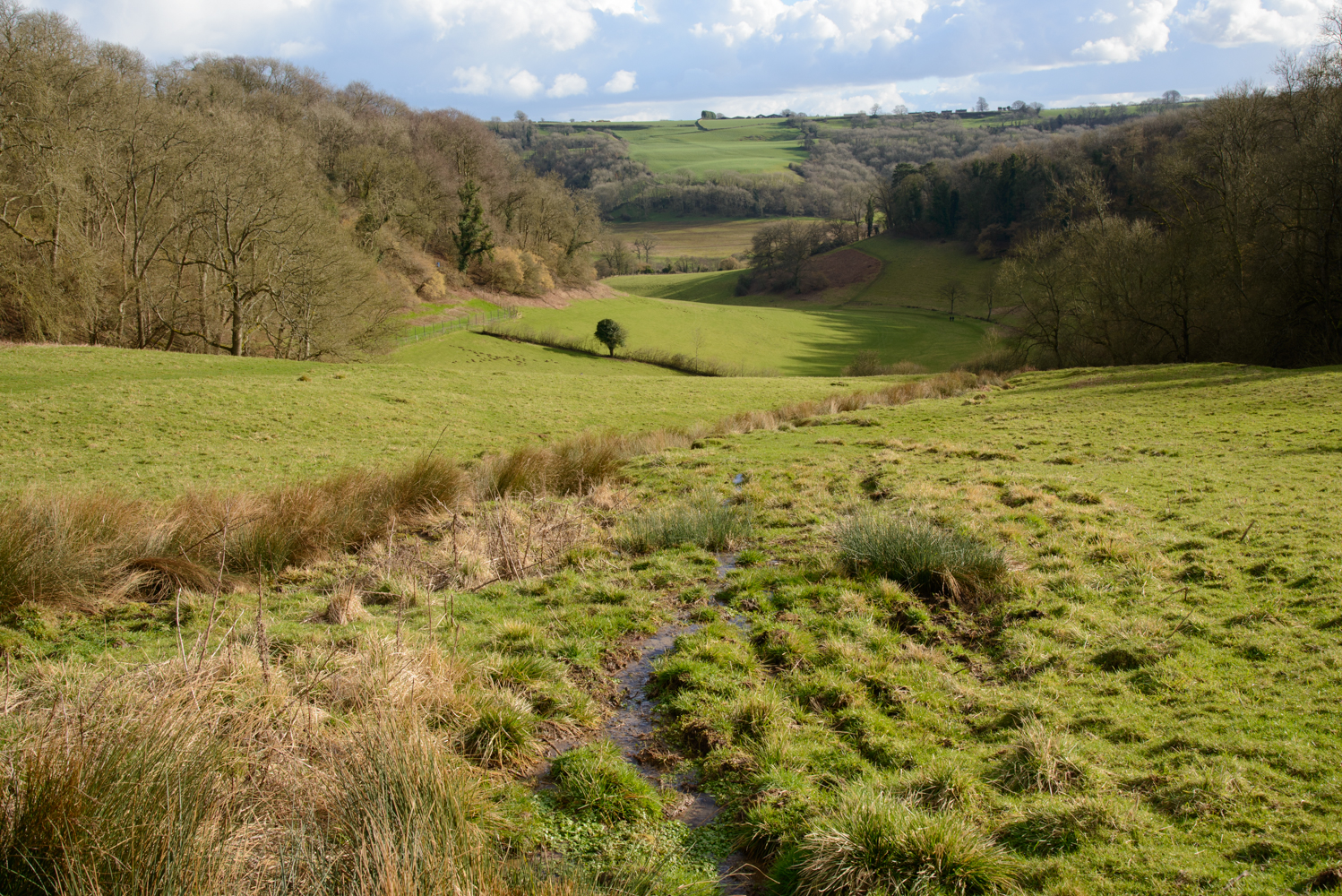
- I don’t just want to capture a set of images that all look the same, I want to show the variety of the countryside in which I live. It is important that each image is different in its own way. I think if I was carrying out this assignment 12 months ago, I would likely create a set of images that look like Fig 1. Essentially a set of very picturesque images but all basically expansive views across valleys hopefully with a leading line through the scene. As a framed picture on the wall, it would look nice, but it would not be a set of images that tell a story of the area as per the brief.
- Whilst the Cotswolds is certainly the countryside, there is plenty of rural industry. This is more the case in the western part of the Cotswolds where I live and therefore I want to include that in my submission. Industry does not have to mean heavy industry. Through reading Land Matters (Wells, 2011) and Perspectives on Place (Alexander, 2015) I have come to understand the different ways in which industry and its placement in the countryside can be depicted. Indeed, this is what I chose to follow up on for Exercise 5.2. This is a topic that I have found myself increasingly interested in and I want to capture some of that in this assignment. A very specific example of my thinking is the image Llanberis Pass, Snowdonia by Morris (Alexander, 2015:123) where industrial is shown to be a car park and coffee shop to allow tourists and walkers to stop before heading on a hike up Snowdonia itself. This is the type of image that is inspiring me for this assignment.
- Colour versus Black and White. All my assignments so far have been colour. I did not feel any need to switch to black and white. In fact my research into Saul Leiter made me more interested in colour than I was before this course and is why I chose to remain in colour even for Assignment 2 which was the one most aligned to street photography and would typically be in black and white. For this assignment though, I want to capture the timeless nature of the Cotswolds. There is a mix of 400 year old cottages, 200 year old industrial buildings and modern industry too. I feel that a set of images presented in Black and White will help to bridge those eras and create a timeless set of images that will act as a cohesive whole. I’m writing this before taking the images so I may turn out to be wrong but that is my thinking ahead of time. What is important to note at this point, is that I want the choice to be for a reason other than aesthetics, and I think this desire to bridge time will lead to monochrome.
With all of the factors above, I am still not 100% sure what images I will take of the area but I have decided simply to go out and spend some days taking images, reviewing, taking more and to see where the exercise leads.
Bibliography
Wells, L. (2011). Land Matters: Landscape Photography, Culture and Identity (Kindle Edition). Kindle ed. I.B. Tauris
Alexander, J. (2015). Perspectives on place. London: Fairchild Books – an imprint of Bloomsbury Publishing.
Figures
Figure 1. Wilkinson, A (2018) Newark Park [Photograph] In: possession of: The author: Newark Park.