Exercise
Select an image by any photographer of your choice and take a photograph in response to it. You can respond in any way you like to the whole image or to just a part of it, but you must make explicit in your notes what it is that you’re responding to. Is it a stylistic device such as John Davies’ high viewpoint, or Chris Steele Perkins’ juxtapositions? Is it the location, or the subject? Is it an idea, such as the decisive moment?
Add the original photograph together with your response to your learning log. Which of the three types of information discussed by Barrett provides the context in this case?
Original Photograph
All the time that I have been studying EYV, I have been reading Land Matters (Wells, 2011) after my tutor spotted a landscape bent in my Square Mile assignment. Reading the book has opened my eyes to the difference between an aesthetic consideration of the landscape (perhaps capturing the sublime or the picturesque) and some expression of what is in the image.
A particular theme, which I touched on in my Assignment 4 is the interplay between nature and mankind.
From Land Matters, the image The Geysers Power Plant (Pfahl, 1983) shown in Figure 1 below, Pfahl has captured the power station and its surrounding mountains in order to contrast the two.
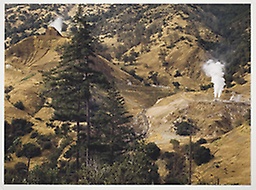
Pfahl has come under criticism though. “This series has been criticised for preoccupation with form… the series articulates modernist concerns with aesthetics and photographic ways of seeing.” (Wells, 2011:62).
Bright (Bright, 1989: 135–6). in particular commenting “By combining conventionally beautiful photographs of socially-loaded subjects with a fashionably ambiguous high-tech/political/ecological theme, the work was highly marketable without offending any potential buyer”
Essentially criticising Pfahl for using aesthetics to widen the attraction of the image beyond those appreciating (or perhaps objecting to) the political statement.
It is Pfahl’s approach that makes the question of context interesting. Looking at the image, it is clear to see the sublime landscape, and the power station, but the image is captured in a way that resembles one captured purely for aesthetic purposes. The Internal Context therefore (the information contained in the image) is confusing. Is this image making a point of the juxtaposition of the two aspects or is simply an image of the vista that happens to have been taken with the power station in it?
It is only when looking at the External Context, the title of the image or the other images in the collection, that it become clear that the image is about the power station itself; the image being called “The Geysers Power Plant” and the collection being a series of images all showing different power plants. Still though, it is not necessarily clear that the image is intended to show just the power plant or the surroundings as well. Another piece of External Context, the title of the collection “Power Places” gives the hint that this is about power, the surroundings and their juxtaposition.
My Image
Driving to my home in the Cotswolds, through the rolling countryside, this power substation reminded me of my chosen image as it stands out as a blot on the landscape. I chose to capture this image as it reminded me of Pfahl’s collection.
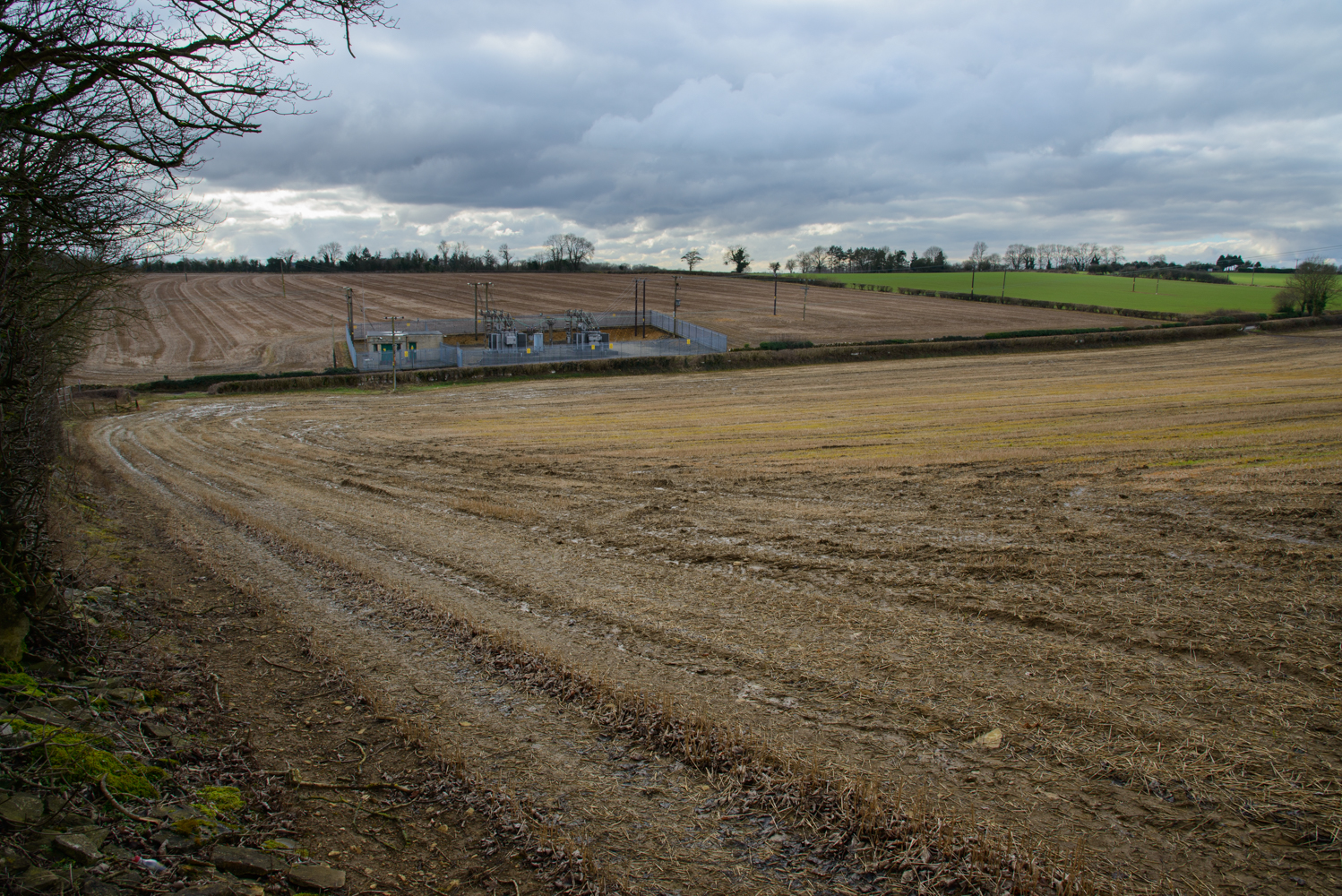
I am responding to Pfahl’s juxtaposition of the power station and the countryside by showing the same juxtaposition. I chose to take a wide shot that showed as much of the countryside as possible whilst still being able to clearly see the power sub-station. Looking at my result, I am still much closer in my framing than Pfahl, I don’t think that there is much doubt that the image is intended to include the sub-station. If I had taken the image from further away or with an even wider lens, perhaps I could have created the same doubt as to the meaning of the image and, like Pfahl, improved the overall aesthetic of the image.
I chose a time of day and weather situation what was deliberately dull because I wanted that to reflect the feeling that this power station evokes every time I see it. I think to contrast the landscape with the sub-station, the image would have been more effective if it was taken in the summer when the farmer’s field was green.
Framing wise, I chose to include the tree at the left and shot fairly close to the ground so that the image had strong leading lines from the field to the power station. These are all things that I would have chosen to do if I was following the standard landscape recipe for an aesthetic image. If I had wanted to solely comment on the sub-station, I would have shot it dead-pan and straight on, but this strange mix of aesthetic and comment is what Pfahl chose to do and therefore I have emulated that here.
Also as Pfahl, I have named the image after the sub-station itself, curiously, the name of the village is “The Camp” which means that even the title is a little confusing. This External Context does though help the viewer understand that the image is indeed intended to be the substation.
(note: there is also a small plastic bottle at the bottom left of the image. I haven’t cropped it out as I wanted to retain the close-uptree on the left which is also something Pfahl did. I chose not to photoshop it out as that is not what this exercise is about).
Bibliography
Wells, L. (2011). Land Matters: Landscape Photography, Culture and Identity (Kindle Edition). Kindle ed. I.B. Tauris
Bright, Deborah (1989). ‘Of Mother Nature and Marlboro Men: An Inquiry into the Cultural Meanings of Landscape Photography’ in Richard Bolton, ed., The Contest of Meaning. Cambridge, MA: MIT; originally published in Exposure 23:3, Fall 1985.
Figures
Figure 1. Pfahl, J. (1983). The Geysers Power Plant, Mayacamas Mountains, California. [image] Available at: http://www.artic.edu/aic/collections/artwork/69916?search_id=1&index=0 [Accessed 4 Feb. 2018].
Figure 2. Wilkinson. A, (2018) The Camp Sub-Station [Photograph] In: possession of : The author: The Camp, Gloucestershire.