I visited “Monochrome” and exhibition at The National Gallery of paintings, rather than photographs. I haven’t included any black and white submission in this course, even for the street photography orientated assignment. It is though a topic that interests me and I was interested to see if any ideas from this form of art could be used in my photography, particularly in Assignment 5 given my interest in black and white and the freedom to capture whatever I love for this assignment.
Monochrome to Remove Distraction
At the exhibition, it was explained that many monochrome (typically shades of grey) images are simply preparation for then creating a colour version. Painters have adopted painting is shades of grey focus on form and shading, the way that the light is falling on an object.
This image by Durer is a stunning example when seen in real life. The detail that the painter has captured the facets of each section of cloth and how the light falls on it is incredibly realistic.
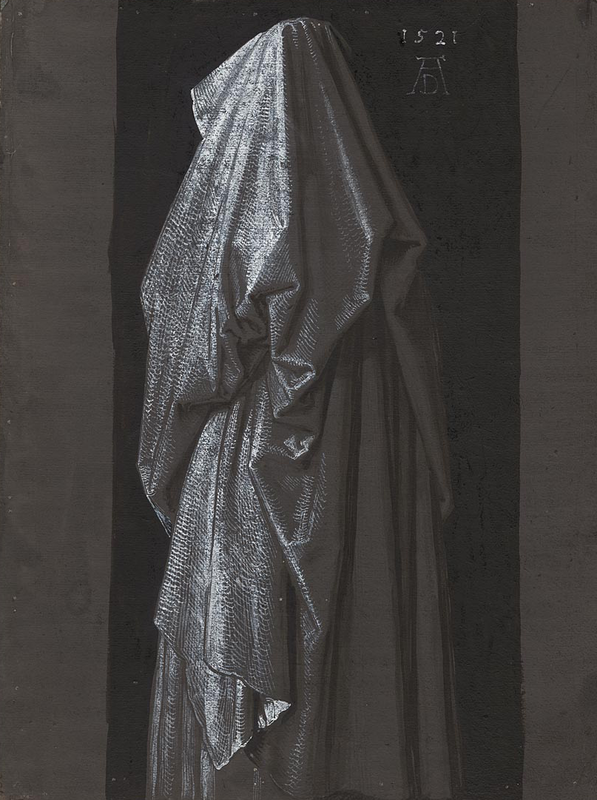
It is very clear that the choice to remove colour has focussed the painter’s and the viewer’s eye onto the light and the structure of the object being painted. It strikes me that this technique could also be used in photography, irrespective of the subject.
Monochrome as a deliberate art form
In the 16th century, the idea of monochrome was taken further and paintings were produced in their own right (Packer and Sliwka, 2017:79), rather than as an abstraction or for preparation of a colour version. This shift led to fully finished paintings that rivalled their colour versions.
From the exhibition the image that I found the most striking was this painting by Ingress. The image is painted entirely in shades of grey and it omits many of the details found in the colour version (ibid:96). Both images are shown below.
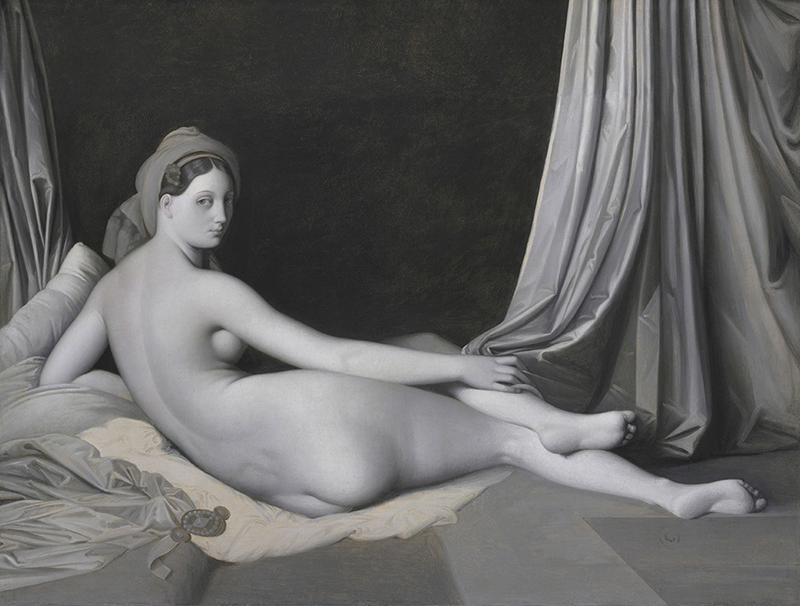
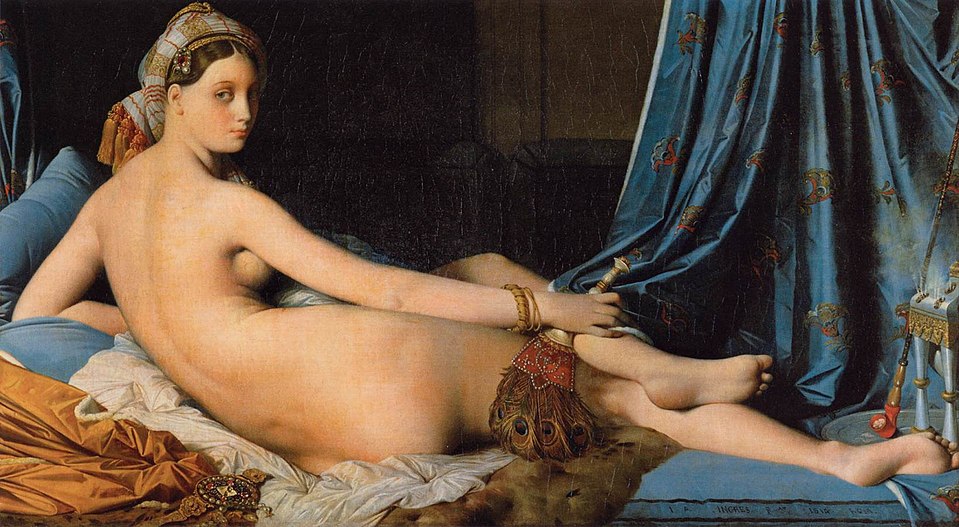
Ingress has understood that the monochrome presentation creates a reduction to the image when compares to its colour version. He has enhanced this further through the elimination of objects in the image too. What is left is a painting which when seen in the gallery leaves when staring for intently at the subject of the painting alone rather than the painting as whole. Again, although the intent of this painting was to produce a monochrome image because that is what was in demand, the use of monochrome is still being used to remove distraction. An important distinction to remember in photography.
Monochrome to simulate other mediums
Painting in shades of grey has been used to simulate other mediums, particularly sculpture. With the ability to study and then depict light alone, it becomes possible to simulate the shading that would be created with a three-dimensional object. When works master this, even when viewed close up, it is difficult to accept that the painting is flat.
This work by Wit was the most convincing for me, genuinely a flat painting.
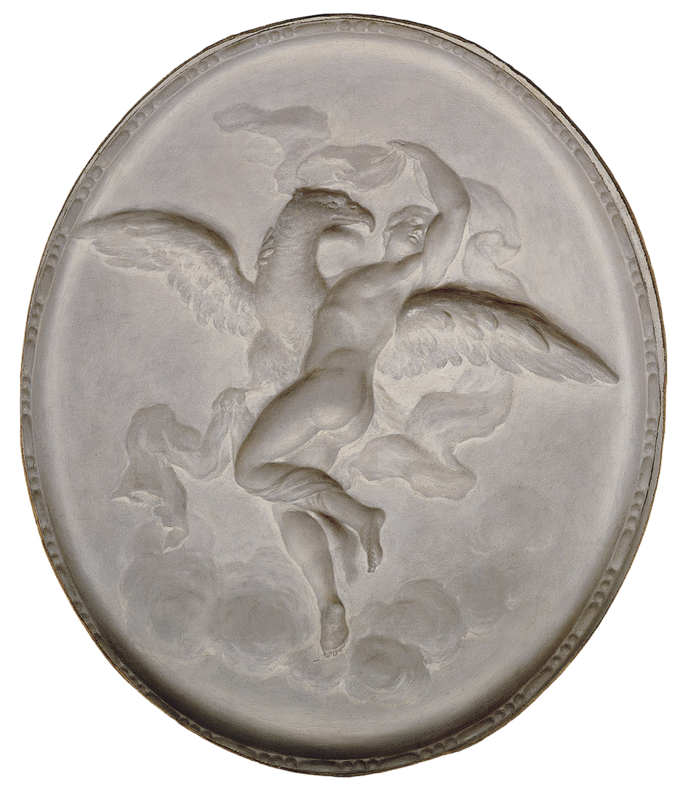
Whilst I don’t think I would be trying to emulate another art form with a photograph (except maybe a painting) I think this aspect of monochrome painting further reinforces how the concept can be used to enhance or depict the textures and lighting of an object.
Monochrome painting in the age of photography
Photography, of course, was only possible in black and white for a long time. It is for this reason that a black and white image has a certain timelessness to it. The photograph can be seen as objective, it records simply what is there, this idea has fascinated artists (ibid:163) who have produced paintings that appear to mimic the photograph but then have a ‘layer’ of expression or creativity applied to them.
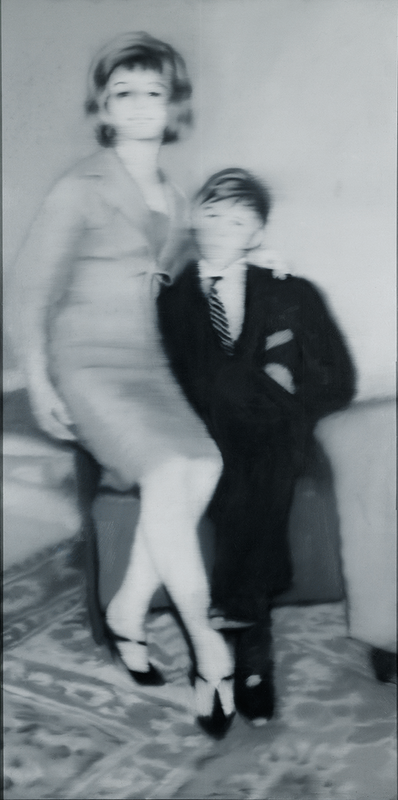
When I first saw this image, I thought to myself ‘why have they included a fuzzy photograph in the exhibition’. Actually, it is a painting, inspired by a photograph. Richter’s technique blurs the image to make it in direct contrast to the photograph (ibid:175). The magazine article that the photograph was taken from referred to the death of a prostitute and was controversial. Richter’s technique of using blurring and monochrome both serve to disassociate the painting from real life, from the emotion. Curiously, although Richter is also using these techniques to separate the painting from the photograph, I think that the very same techniques could also be used back in the medium of photography to separate the photograph from real life.
Figures
Fig 1 Durer, A (1521). A Woman in Netherlandish Dress seen from behind. [Brush and black ink, heightened with white]. At: http://www.alaintruong.com/archives/2017/10/29/35815537.html (Accessed on 20 January 2018).
Fig 2 Ingres, J (1824). Odalisque in Grisaille [Oil on Canvas]. At: http://www.alaintruong.com/archives/2017/10/29/35815537.html (Accessed on 20 January 2018).
Fig 3 Ingres, J (1814) La Grande Odalisque [Oil on Canvas]. At: https://en.wikipedia.org/wiki/Grande_Odalisque (Accessed on 20 January 2018)
Fig 4 De Wit, J (1739) Jupiter and Ganymede [Oil in canvas]. At: http://www.alaintruong.com/archives/2017/10/29/35815537.html (Accessed on 20 January 2018).
Fix 5 Richter, G. (1966). Helga Matura with her Fiancé. [Oil on Canvas]. At: http://www.alaintruong.com/archives/2017/10/29/35815537.html (Accessed on 20 January 2018).
Bibliography
Packer, L. and Sliwka, J. (2017). Monochrome Painting in Black and White. 1st ed. London: National Gallery Company Ltd.