What I Feel About ‘The Decisive Moment’
I feel that the decisive moment has become too synonymous with street photography which itself, outside of the very identifiable styles of well known photographers, has moved towards simply being black and white images taken of people reasonably close up out in the street; preferably with some unusual expression on their face or with them making a gesture. I wonder if this dilutes the real intent of the phrase when Cartier-Bresson invented it.
The research I have carried out on Wiinogrand and Leiter in Part 2 of this course disproves my gross over-simplification of street photography, but without research, I feel that the ‘man on the street’ version of street has gone that way and has taken the decisive moment with it.
Ghazzai states “Granted that the decisive moment is more of a cliché than a reality, even for its own creator, it still has the status of a myth with too much of an unconscious impact on photojournalism to be dismissed too easily” (Ghazzai, 2004) implying that he too feels the idea has gone too far. However, he also acknowledges that it is a topic that photographers keep coming back to.
But when the topic is reviewed by him, he seems to put it down to gestures. Ghazzai stating “Cartier-Bresson’s photography is at its best with bodies and their gestures.” (ibid).
I am not so sure though. It would be relatively easy to get people to gesture by moving actively along a street. Perhaps in the style described by Resnick as he recounts an exercise with Winogrand.
“We quickly learned Winogrand’s technique–he walked slowly or stood in the middle of pedestrian traffic as people went by. He shot prolifically. I watched him walk a short block and shoot an entire roll without breaking stride” (Resnick, 1988)
But this to me does not sound like a decisive moment. This sounds like mass shooting of images and then being selective at the edit stage to choose only those where people have reacted to the photographer perhaps. Nothing about this approach implies a time aspect.
In Pantell’s review of The Present by Paul Graham (Pantell, 2012), he discusses how the book is presented as series of dual images with each image in the pair being taken in the same place but at a different point in time. The result is more like a narrative than a specific point in time. Pantell sees this as the “antithesis” of the decisive moment but I actually see this as a link back to Cartier-Bresson and his concept because it brings up the concept of time.
In his film (Cartier-Bresson, 2001.) Cartier-Bresson talks about an image needing to show what has gone before and what will go after. When he talks of travel photography he talks of it needing to show “the old and the new”. Cartier-Bresson is attempting to tell a story in a single image, and it is this precipice between before and after, this precise moment in time that he is capturing in a single image and calling the decisive moment. This act is nothing to do with gestures, it has everything to do with telling a story and that is just the same as the approach taken by Graham.
Point 1 for me is therefore that the decisive moment tells a story through time – one can tell what has gone before, what is happening now, and what will likely happen next. Time is vital to this concept.
The second point made by Cartier-Bresson (Cartier-Bresson, 2001.) is that the framing of the image must be well balanced and geometrically sound. Again, this is not some random framing that happens to exist as the image is captured of a particular subject. This is a deliberate act to ensure that as well as achieving the object of telling a story, the image is captured with good framing and geometric balance.
Point 2 for me is therefore the framing of the image – it needs to be well balanced.
My Exercises
Thinking of the exercises in this part of the module, I have captured bursting water balloons at 1/64000th of a second and crowds fading away with a 60 second exposure. In both exercises my images deliver on what I have concluded makes a decisive moment, it is possible to see what was there and what is going to happen next.
The decisive moment in my view is not therefore a fraction of a second, or sixty seconds, it is the length of time needed to satisfy the story telling criteria.
Point 3 in my view is therefore that it is the job of the photographer to choose the length of the exposure to make that possible. The work by Sugimoto and Wesley certainly fit this criteria.
But on the Other Hand
There are plenty who would disagree that there is a need for a decisive moment in photography. Indeed, it would be a loss to a broad range of material to develop an understanding of the decisive moment and then exclude all other ideas as a result.
On their blog site, PhotoPedagogy (PhotoPedagogy, 2017) in describing their (In)decisive moment, make the argument that photography can be more aligned to photographing simply ‘what is’ and that this should therefore be a timeless pursuit, abandoning the idea of the before and after.
This is an image I took in Southbank, London that shows old and new quite literally, but it doesn’t tell a story and given it does show old and new, it isn’t really timeless.
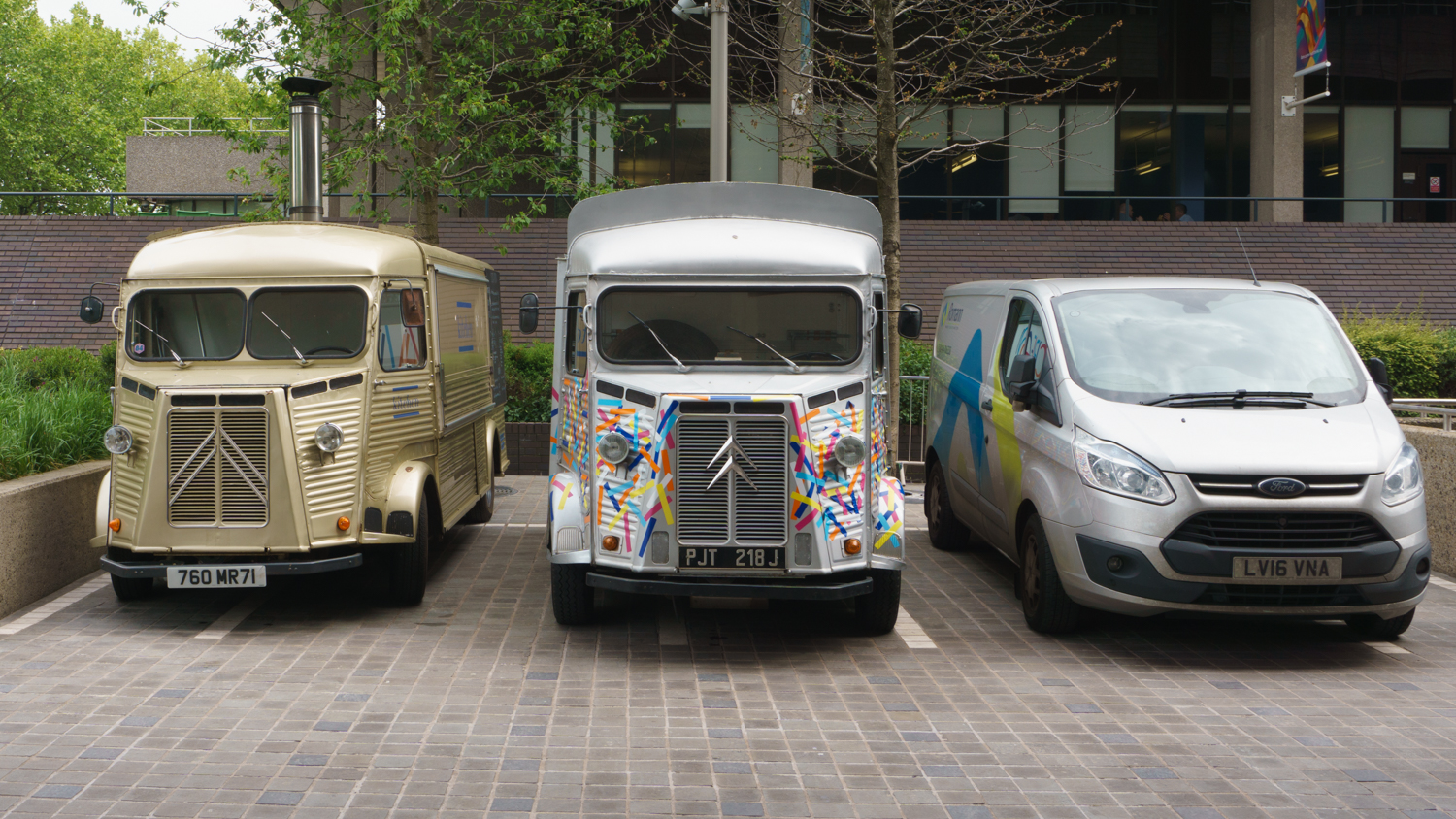
So what is missing? What category does this image sit in?
A clue could be in the same blog, Nick Waplington is quoted as saying “My position as photographer and artist has always been about trying to make pictures that ask questions as opposed to pictures that draw conclusions.” (Waplington, 1998, cited in PhotoPedagogy, 2017).
I am struck by this quote when thinking about story telling. It seems to me that the most effective stories are the ones that make one think, that leave the ending open for discussion or start in a way that makes the reader imagine their own beginning. If a photograph ‘decisive moment style’ tells the beginning, happening and end, then does this mean that whilst the viewer has the whole story in an instant, their ability to imagine beyond that is restricted? Does that make the image less interesting? Or mean that the viewer does not need to pause and think? I personally feel more drawn to and intrigued by an image that makes the viewer stop, think and imagine their own possibilities.
On the topic of interest, I have found over the duration of this module that I am feeling more and more drawn to the notion of a set of images rather than a single stand alone image. I feel that the creative tension surrounding an image can build if a set of images are edited well (indeed I am learning a lot about the converse of this when a set of images is edited badly!). Kim holds a similar view “More recently I have switched from working on a single-photograph approach to a more project-focused approach. I feel one of the strenghts of working on projects is that it helps you stay focused, and also have more of a message and statement in your photographs.” (Kim, 2017). As an aside, my research into this blog has led me to research Martin Parr. Parr’s approach to street photography is different again; my research can be seen here.
This alternative perspective leads me to the point that if full expression can only be achieved in a set of images, and even then only if they leave the viewer free to imagine, then how can there be a single decisive moment?
I think my conclusion to this alternative view is that both views can co-exist; there can be images grounded by the decisive moment, and there can be images that do not attempt to imply any kind of time based aspect. Both approaches produce their own unique results and neither is more correct than the other, they are simply different. What is important is to consciously choose which approach is being adopted at any given time and certainly to build a cohesive set, it is important to be consistent across that set.
As I progress in building my personal style I may choose one or the other, or I may chose one for a given scenario and change for the next. I have a feeling at this point that I feel more drawn to the ‘timeless’ view on the world and in the choice to leave interpretation open to the viewer; this I think aligns to my attraction to deadpan earlier in this module. For now though, I am open to exploring both and understand what works and does not work for my particular brand evolution.
In summary on the Decisive Moment
I think the decisive moment can be summed up in three points:
i) capturing a moment that can tell a story, leaving little room for extra interpretation for the viewer.
ii) capturing that moment with a well balanced image, and
iii) capturing the photograph with an exposure time that generates an image that tells that story in one look.
Finally, I think it is important to understand wether or not this particular approach plays a part in the set of images being captured at the time or how it aligns to the wider personal style of the photographer.
Bibliography
Ghazzai, Z. (2004). decisive moments. [online] Zouhairghazzal.com. Available at: http://zouhairghazzal.com/photos/aleppo/cartier-bresson.htm [Accessed 7 May 2017].
Resnick, M. (1988). Coffee and Workprints: A Workshop with Garry Winogrand. [online] Black and White World. Available at: http://www.photogs.com/bwworld/winogrand.html [Accessed 23 Mar. 2017].
Pantell, C. (2012). photo-eye | Magazine — The Present. [online] Photoeye.com. Available at: http://www.photoeye.com/magazine/reviews/2012/05_17_The_Present.cfm [Accessed 7 May 2017].
Cartier-Bresson, H. (2001). L’amour tout court. [online] Available at: https://www.youtube.com/playlist?list=PL707C8F898605E0BF [Accessed 16 Apr. 2017].
PhotoPedagogy. (2017). The (In)decisive Moment. [online] Available at: http://www.photopedagogy.com/the-indecisive-moment.html [Accessed 9 May 2017].
PhotoPedagogy. (2017) Waplington, N. The indecisive memento. 1st ed. London: Booth-Clibborn.
Kim, E. (2017). 10 Things Martin Parr Can Teach You About Street Photography. [online] erickmphotography. Available at: http://erickimphotography.com/blog/2012/03/26/10-things-martin-parr-can-teach-you-about-street-photography/ [Accessed 9 May 2017].