I personally tend to think of long exposures as being 1 or 2 seconds, or maybe a few minutes if using a dark ND filter such as a Lee Big Stopper.
Two photographers introduced here take this idea to a whole new level.
Hiroshi Sugimoto
Sugimoto captures images showing a theatre and an entire film screening in one image – starting from the title and finishing when the credits are shown. What is captured by completion is what looks like an empty theatre with a bright white screen. A typical image of his is shown here in Figure 1.
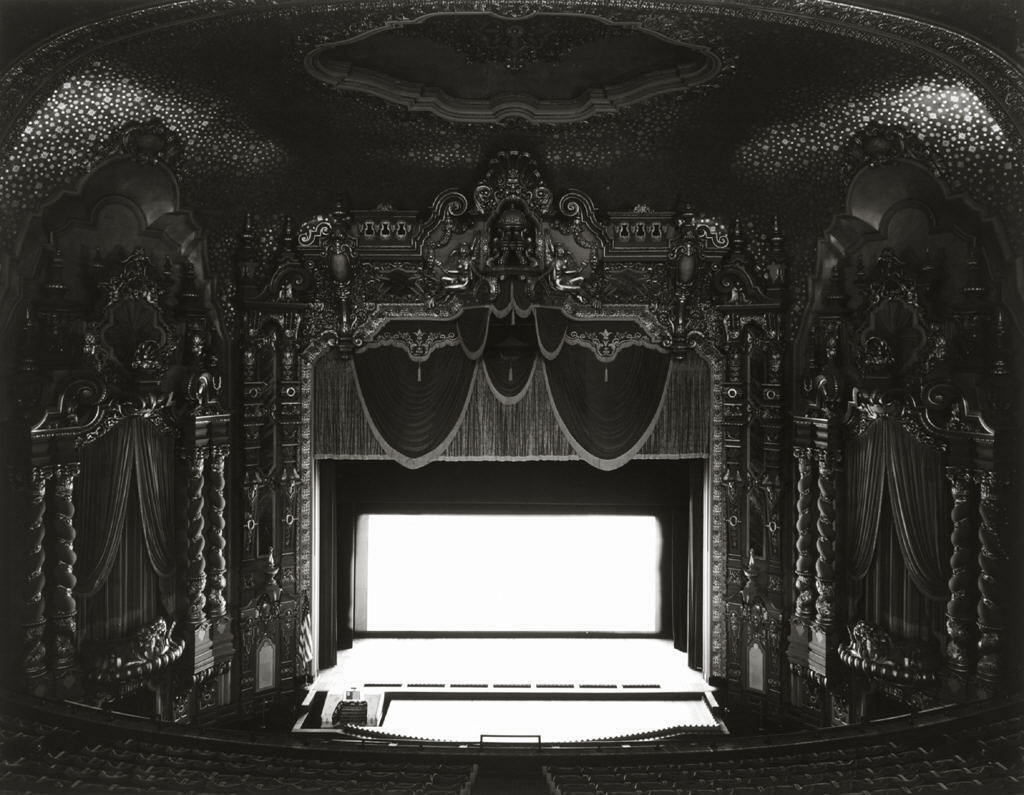
What has gone into creating that image is all of the projected images for the entire film, which adds up to a white glow. Visitors to the theatre, although present, are never in one place long enough to register in the image.
I find these images ghostly. Firstly, one knows that the bright image is the summation of a whole film, perhaps 1 to 2 hours of projection captured in a single shot. Knowing that people have been present but are not shown in the image is to me even more intriguing and that is the part I find ghostly, the fact that they were there, but cannot be seen.
In his film, Sugimoto (Sugimoto, 2009) describes how the empty theatre provides a frame from the nothingness of the film that is left showing as a bright white light. I fully agree with his point of view that the apparently empty theatre frames the ‘film’ but I also think that this emptiness signifies the brief passage of time that humans spend in the theatre; passing through so quickly, that they cannot even be seen in a timeframe as long as 2 hours. Perhaps this extends to our place on the earth and the shortness of our lives compared to the world around us – if the passage of time of the entire earth were summed up into a 1 hour film, human presence would not even register.
Technically, these images are difficult to take. If a film last two hours, then to be exposed correctly, the variation in exposure for a single stop is very significant. A one stop under exposure would mean shooting for just one hour, or four hours for a one stop over exposure.
Impressive though this is, even these images though are short compared to those of Wesley.
Michael Wesley
Wesley captures photographs that are taken as a single image over two to three years and show, in this single picture, the changes that take place over that time frame. An example here in Figure 2 is of the reconstruction of the Museum of Modern Art in New York. In which the shutter was left open for 34 months (Martinez, 2012).
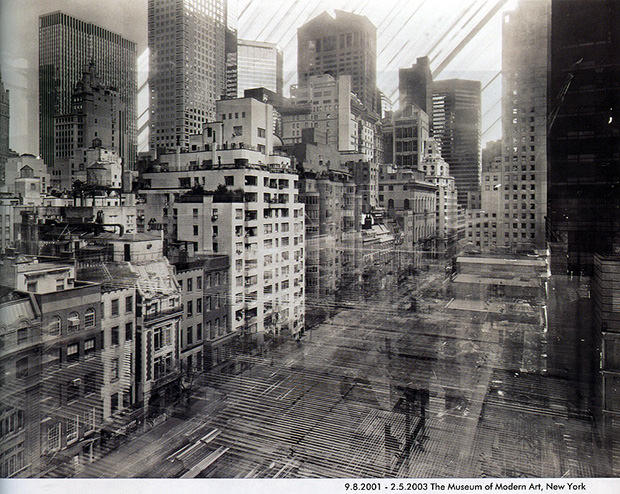
Once again, ghostly images are created, but this time, unlike Sugimoto, not due to the absence of what was there being visible. This time, what was there originally can be seen fading away and what is new can be seen slowly emerging. This is a concept that is hard to fully comprehend at the outset.
In the earlier exercise carried out in this section of the course, the emphasis was on using high speed photography to capture an instant of time that cannot normally be seen by the human eye. Fantastic effects can be seen that would otherwise not be possible but at the same time, it is easy to comprehend what one is looking at.
The notion of images taken over 3 years at a simple level can be understood, perhaps as the concept rather than the image. But then when this is translated into an image, a view is given that takes a long while to process and understand what is happening. The fading of something that is no longer there is achieved partly because of its disappearance but also because of the creation of something in its place; all of this registers on the same spot of film and results in ghostly remnants appearing.
A clue as to the length of the shot can be seen in the background with the bright white stripes. These stripes are created by the passing of the sun. The multitude of stripes shows how much the sun changes position over the course of the year.
The idea that a whole three years of events can be captured in a single still image rather than a time-lapse or normal movie is simply beyond anything I would have conceived. The concept certainly challenges the idea of a ‘decisive moment’, unless perhaps that moment is a mere three years in a city’s two-hundred-year history.
Learning
This piece of research builds upon the high speed photography; in that exercise, I came to learn that there are perhaps decisive moments that cannot be seen without the aid of technology.
At the opposite end of the scale, what is portrayed by these ultra long exposures could be acheived in other ways, such as a series of stills, but that would not carry the same impact as what is done here in one image.
The decisive moment here then, seems not to refer to a specific moment in time as one might think of it ordinarily, but in fact relates to the period of time over which the thing you are trying to capture, to make a statement or image of, occurs. This could range from 1/8000th of a second to 3 years as Wesley shows.
This is a different mindset. It is a mindset of capturing something in relation to the endless passage of time, rather than the fact of something just ‘being’. Part of the statement the image makes is a commentary on the time the thing captured took to happen; as well as the thing itself. This thinking is very distinct from a simple choice of exposure length mainly to achieve sharpness or motion blur. It is a mode of thinking that had not reached my consciousness before but going forwards, it certainly will.
Bibliography
Sugimoto, H. (2009). Contacts: Hiroshi Sugimoto 2. [online] YouTube. Available at: https://www.youtube.com/watch?v=rY3nGoZqw9U [Accessed 14 Apr. 2017].
Martinez, E. (2012). Michael Wesely: the experience of time in the longest exposed photographs. [online] Pocket Memories | Analog photography & giclée art poster prints. Available at: https://pocketmemories.net/ideas/features/michael-wesely-experience-time-longest-exposed-photographs [Accessed 14 Apr. 2017].
Illustrations
Figure 1. Sugimoto, H. (1980). Sugimoto Ohio Theatre 1980. [image] Available at: http://www.c4gallery.com/artist/database/hiroshi-sugimoto/movie-theatres-theaters/sugimoto-ohio-theater-1980.jpg [Accessed 14 Apr. 2017].
Figure 2. Wesely, M. (2003). The Museum of Modern Art, New York. [image] Available at: https://pocketmemories.net/ideas/features/michael-wesely-experience-time-longest-exposed-photographs [Accessed 14 Apr. 2017].