Research
The Man
I have selected this photographer for specific research because of the work he produced in response to his fellowship award from Guggenheim to investigate the effects that media has on public events. Given the context of media, this tended to mean that he was photographing large events and therefore crowds.
His approach ‘made him belong to experimental photography of the 60’s-70’s, forgetting about the frame and close-ups as if one single picture could sum up the whole event itself.’ (Photography in America, 2012). This work was produced in a series called “Public Relations” and it is this series that I have drawn some specific images from.
First though, in my research of Winogrand, I came across a wonderful article (Resnick, 1988) describing a course that the author took working with Winogrand.
A particular point caught my attention with Resnick (ibid) saying ‘We quickly learned Winogrand’s technique–he walked slowly or stood in the middle of pedestrian traffic as people went by. He shot prolifically. I watched him walk a short block and shoot an entire roll without breaking stride.’. I love the animation that the phrase evokes, I can just imagine a relentless enthusiasm by Wingrand to capture the images, especially if you read the whole article. What struck me though is that in today’s digital age, where shot taking can be prolific without much cost, we often see reference to the idea that using film causes you to slow down and be more considered. This recital seems to contradict that and leans more towards a technique of capturing everything and sorting our the selects in the editing process.
Ultimately, again stated by Resnick is that the whole technique can be summed up as ‘no preconceptions’. Something to come back to when I reach the ‘decisive moment’ part of the course perhaps.
I do like the spontaneity of the idea this leads nicely back to what I learnt looking at Winogrand’s Public Relations images.
Public Relations
This project was created to understand the relationship between media and public events. As public events tend to draw a lot of people, these images serve as a good reference for crowds. The “Public Relations” series was first published to accompany a 1977 exhibition at The Museum of Modern Art, New York (Photography in America, 2012).
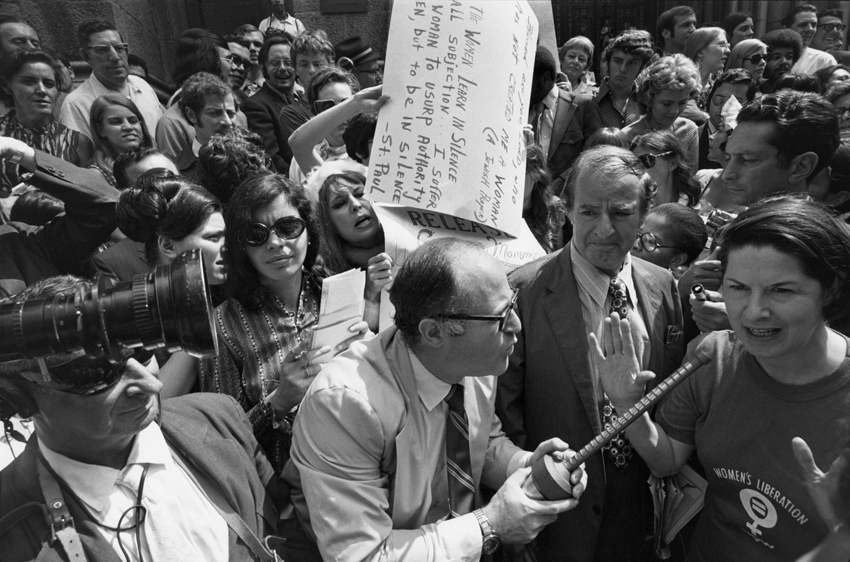
What can be seen in every image I have selected is that Winogrand has captured the crowd, but has always managed to capture a smaller number of individuals within the context of that crowd. It is almost as if those individuals explain the context of the crowd, which lends importance to the crowd but at the same time, the fact that the crowd exists lends weight to the actions of the individuals.
In Women’s Liberation March (see Fig 1), I am sure it would have been possible to capture an image of a large number of women walking along. But this image shows a single women being interviewed by the media against a backdrop of a crowd of women, one with a placard. Showing the woman and the media in this way conveys the impact of the march, the interest in it, as well as the fact that there was a march as well.
This same effect can be seen in other images. In Elliot Richardson Press Conference (See Fig 2) the crowd is a very large mass of people but dead centre of the image, a single individual face can be seen and draws ones attention, again that person has a mic held up to him so we make the same linkages as described for Fig 1.
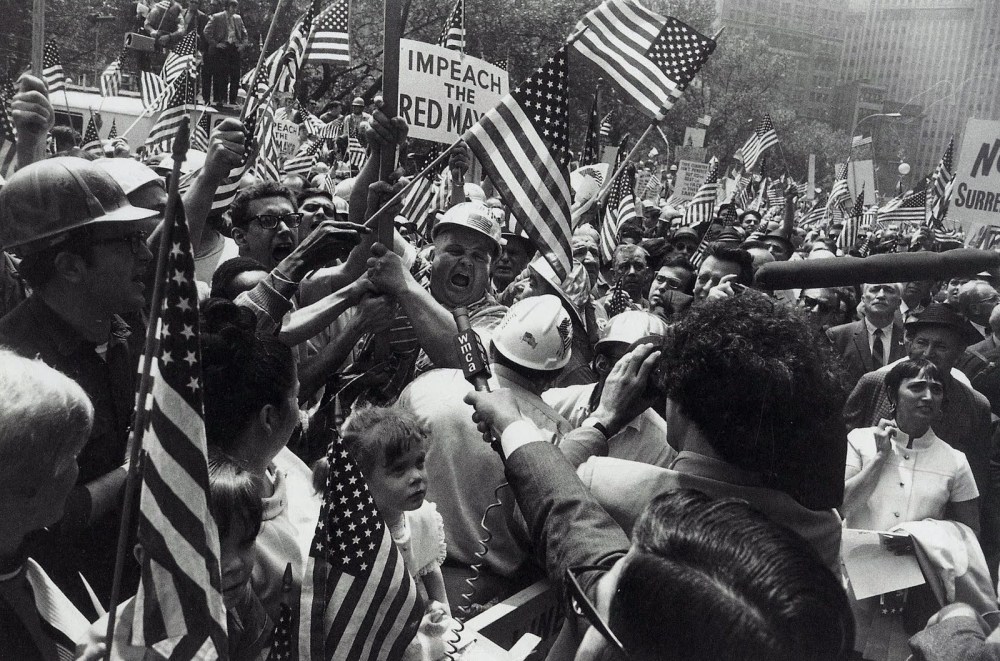
This framing is repeated time and again with a large number of his shots and backs up the idea that the overall framing is not the primary concern here, it is the identification of a core individual and then the portrayal of that individual against the backdrop of the crowd.
Learnings
Three key lessons have been observed in this research:
- The importance of capturing moments as they arise, starting out with no preconceptions
- The editing process to turn a resultant large number of images into a smaller cohesive set deserves at least as much effort as the capture itself
- The impact of capturing a crowd can be greatly enhanced by ensuring that a person or point of interest is key in the frame and that this is given a backdrop of the crowd itself.
Bibliography
Photography in America. (2012). Garry Winogrand – “Public Relations”. [online] Available at: https://photographyinamerica.wordpress.com/2012/02/28/garry-winogrand-public-relations/ [Accessed 19 Mar. 2017].
Resnick, M. (1988). Coffee and Workprints: A Workshop with Garry Winogrand. [online] Black and White World. Available at: http://www.photogs.com/bwworld/winogrand.html [Accessed 23 Mar. 2017].
Figures
Figure 1. Winogrand, G. (1971) Women Liberation March [Photograph] At: https://photographyinamerica.wordpress.com/2012/02/28/garry-winogrand-public-relations/ [Accessed 19 Mar. 2017]
Figure 2. Winogrand, G. (1973) Elliot Richardson Press Conference [Photograph] At: https://photographyinamerica.wordpress.com/2012/02/28/garry-winogrand-public-relations/ [Accessed 19 Mar. 2017]